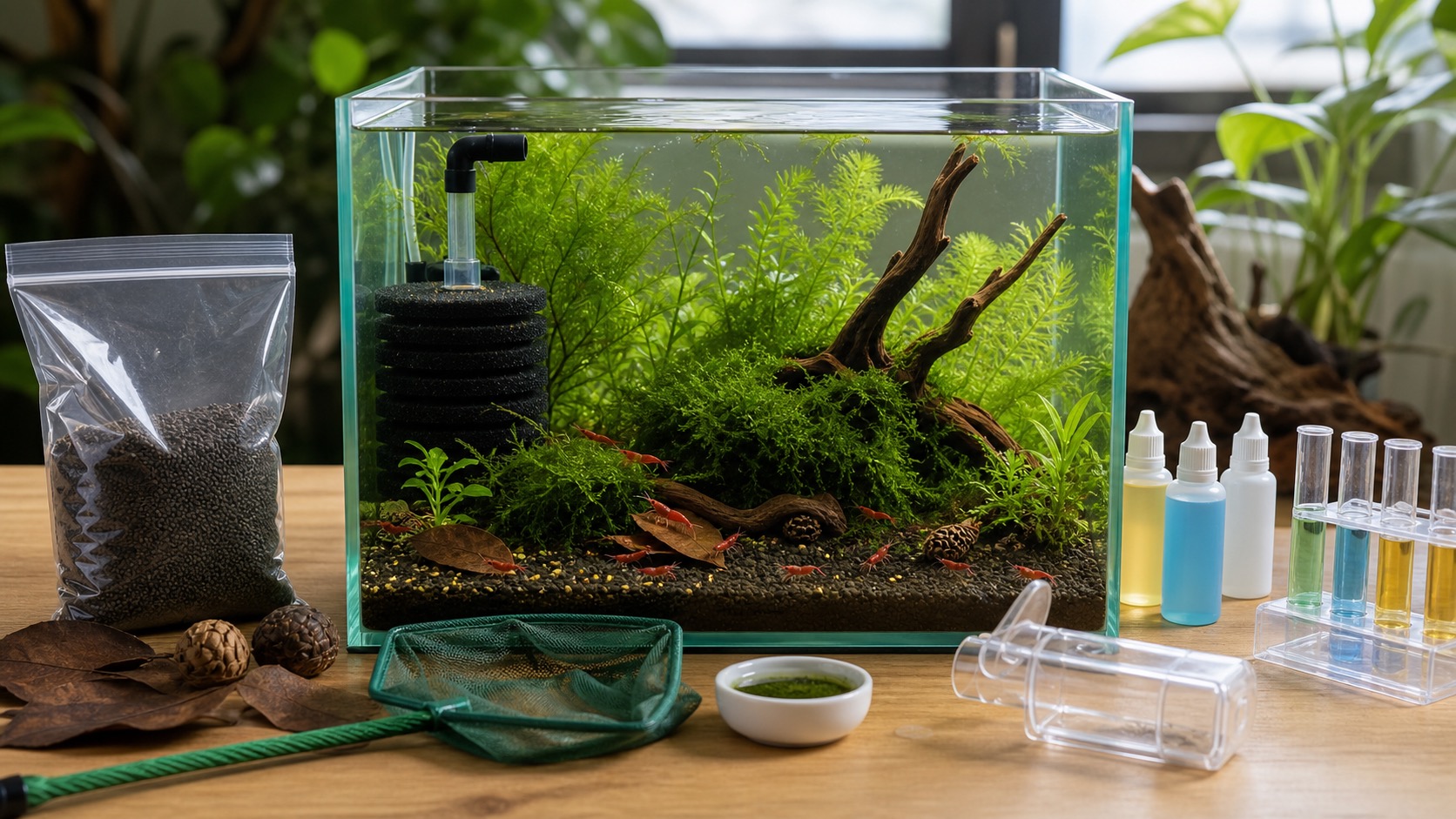
Beginner guide to keeping shrimp: from first tank to stable colony
Learn how to start a safe shrimp aquarium step by step: species choice, tank size, filter, cycling, water, feeding, maintenance and first aid.
Written by
- Published
- Updated
- Reading time
- 7 min read
A first shrimp aquarium looks small and simple, but shrimp depend on calm, mature and predictable conditions. Most beginner losses are not caused by a rare disease. They come from a tank that is too young, the wrong species, unsuitable water, too much food or fast corrections after a test result. This guide turns your first tank from a guess into a system a colony can live in.
Use this as the Shrimpcent starting map. The water-parameters guide goes deeper into pH, GH, KH, TDS, temperature and the nitrogen cycle. This beginner guide turns that knowledge into choices you make before buying animals: which species fits your water, what tank size gives enough margin, which filter is shrimp safe, when the tank is mature enough and what to do during the first month.
The beginner core
The safest beginner route is to choose a shrimp that fits your water and routine. For many keepers that means Neocaridina, such as Red Cherry, Blue Dream, Yellow Neon or Bloody Mary. They have more tolerance than sensitive Bee Caridina, Taiwan Bee, Pinto, Boa or Sulawesi shrimp. More tolerant does not mean unbreakable. Neocaridina also die in an uncycled tank, with ammonia, nitrite, copper, temperature shock or sudden water-parameter swings.
A good beginner tank has five things: enough volume to stay stable, a mature biofilter, shrimp-safe filtration, plenty of biofilm and a setup matched to the chosen species. When this base is right, color, breeding and plants become much easier.
Tank size and location
A 20 liter shrimp tank can work, but 30 to 40 liters gives beginners more margin. More water buffers temperature, feeding mistakes and small measurement differences. Avoid direct sun, radiators and weak furniture. Shrimp do not handle heat spikes well. A quiet place with a day-night rhythm, power and room for water changes matters more than a decorative sunny spot.
Use a lid or calm rim if you want to reduce evaporation. Evaporation is not a water change: minerals stay behind while water leaves. Top off evaporated water with low-mineral water, preferably RO water if that is part of your system, and do water changes with water prepared to the right values.
Filter, substrate and layout
A sponge filter is often the safest beginner filter. It does not suck in shrimplets, gives bacteria and biofilm a large surface, and adds oxygen. Hang-on and canister filters can work, but the intake needs a fine prefilter sponge. Shrimp graze everywhere, including filter intakes.
For a simple Neocaridina tank, inert gravel or sand is usually easier. Active soil helps many soft-water Caridina, but in a beginner Neocaridina tank it can lower pH and KH in a way you need to understand. Choose hardscape carefully: calcareous rock can raise GH, KH and pH. Wood, moss, leaves and rough surfaces are useful because biofilm grows on them.
Design the tank for grazing and hiding. Moss, fine plants, catappa leaves, cholla wood and porous rock all add surface. Do not keep the tank sterile. A shrimp tank may look mature: a thin biofilm and natural film are food and stability.
Choose water before choosing shrimp
Test your tap water before buying animals. For a beginner tank, pH, GH, KH, TDS, ammonia, nitrite, nitrate and temperature are the core. Many Neocaridina do well in clean, stable tap water with measurable GH and KH. Sensitive Caridina usually need RO water with GH+ and active soil. Sulawesi shrimp are not a beginner choice: they need warm, alkaline, oxygen-rich and very stable water.
Do not follow a generic table without looking at the species. A pH that is fine for Red Cherry can be wrong for Taiwan Bee. KH that helps Neocaridina stability can exhaust active soil in a Bee setup. When in doubt, do not choose the most sensitive shrimp. Choose the shrimp that fits water you can make reliably.
Cycling: the tank must be biologically mature
Shrimp should not go into an aquarium that is only filled and clear. The filter and surfaces need bacteria that convert ammonia to nitrite and then nitrate. Ammonia and nitrite must test zero before shrimp are added. A tank can look clear and still be biologically unsafe.
Cycling often takes several weeks. Use reliable liquid tests, feed the system or dose an ammonia source in a controlled fishless-cycle method, and test until ammonia and nitrite disappear after the bacteria can process waste. Do not add shrimp to "start" the cycle. That is unnecessary risk.
Maturity is more than nitrogen. Shrimp live from biofilm, micro-organisms and surfaces. A tank that runs quietly for another two to four weeks with plants, moss and leaves is often better than a newly cycled bare tank.
Buying and acclimating shrimp
Buy healthy animals from stable hobby-bred stock rather than the brightest color from unknown conditions. Ask for the water values. Look for active grazing, normal color, no mass lethargy, no dead animals in the sales tank and no visible parasites or white haze. New shrimp are vulnerable because of transport, temperature difference and different water.
Acclimate more slowly when transport water and tank water differ. Drip acclimation is especially useful when TDS, GH, KH, pH or temperature are different. Do not pour transport water into the aquarium. Keep light low, avoid heavy feeding on day one and let the shrimp recover.
Feeding without polluting the tank
Beginners almost always overfeed. Shrimp need food, but in a mature tank they also eat biofilm, algae film, leaves and tiny particles. A small amount of quality shrimp food a few times per week is often enough for a small starter group. Remove leftovers if they remain. Too much food causes bacterial growth, oxygen stress, snail booms and rising nitrate.
Shrimplets benefit from stable biofilm and fine food that does not become a rotting pile. Vary calmly: staple food, leaves, nettle, vegetables only briefly and cleanly prepared, and minerals through good water and suitable food. Feed less during heat, ammonia, nitrite or unexplained deaths.
Maintenance: small, regular and measurable
A stable shrimp tank does not need deep cleaning. Test weekly at first. Change small amounts of water with prepared water that matches temperature and minerals. For many beginner tanks, 10 to 20 percent weekly or every two weeks is a calm starting point, depending on nitrate, feeding and tank size. Prepare new water outside the tank.
Never squeeze a sponge filter under hot tap water. Rinse it gently in removed aquarium water if flow clearly drops. Leave substrate, moss and wood mostly alone. Siphon dirt in targeted spots, but do not remove all biofilm. Write down tests and maintenance. Trends prevent panic.
Problems in the first weeks
If shrimp swim wildly, sit still, fall over, turn pale, hide in large numbers or die after a water change, test broadly: ammonia, nitrite, nitrate, pH, GH, KH, TDS and temperature. Also check oxygen, recent maintenance, new plants, medication, snail treatment, metals and food. Do not correct blindly. A second big change can be the second hit.
No babies at first is not always a problem. The colony needs to settle, juveniles need to mature, and there must be enough cover and biofilm. If there is no breeding for months, check species, sex ratio, temperature, food, stress, predation and water stability.
A safe 30 day starter route
- Choose the species group first. For most beginners: Neocaridina in suitable tap water.
- Buy the tank, filter, substrate, plants, test kit, thermometer, food and maintenance tools before animals.
- Set up the tank with plenty of surface, moss and a safe filter intake.
- Cycle until ammonia and nitrite reliably test zero.
- Let biofilm grow and check that values stay stable.
- Buy a starter group from a source that can tell you water values.
- Acclimate slowly, feed lightly and avoid major changes in week one.
- Test weekly, change small amounts of water and track trends.
Beginner FAQ
Which shrimp is best for beginners?
Neocaridina davidi is usually the best first choice, especially Red Cherry or locally bred color lines. Choose shrimp bred in similar water.
How long should a shrimp aquarium cycle?
Do not use the calendar alone. The tank must process ammonia and nitrite, and both must test zero. This often takes several weeks, with extra biofilm maturity being helpful.
Do shrimp need a filter?
For beginners: yes, strongly recommended. A sponge filter is cheap, safe for shrimplets and good for bacteria and biofilm.
How often should I feed shrimp?
A small starter group does not need heavy daily feeding. Give small portions and remove leftovers. In a mature tank shrimp also eat biofilm and leaves.
Can shrimp go straight into a new tank?
No. A new tank without a stable nitrogen cycle can produce ammonia and nitrite, which can kill shrimp quickly.
Sources and review
Last content review: 15 December 2025.