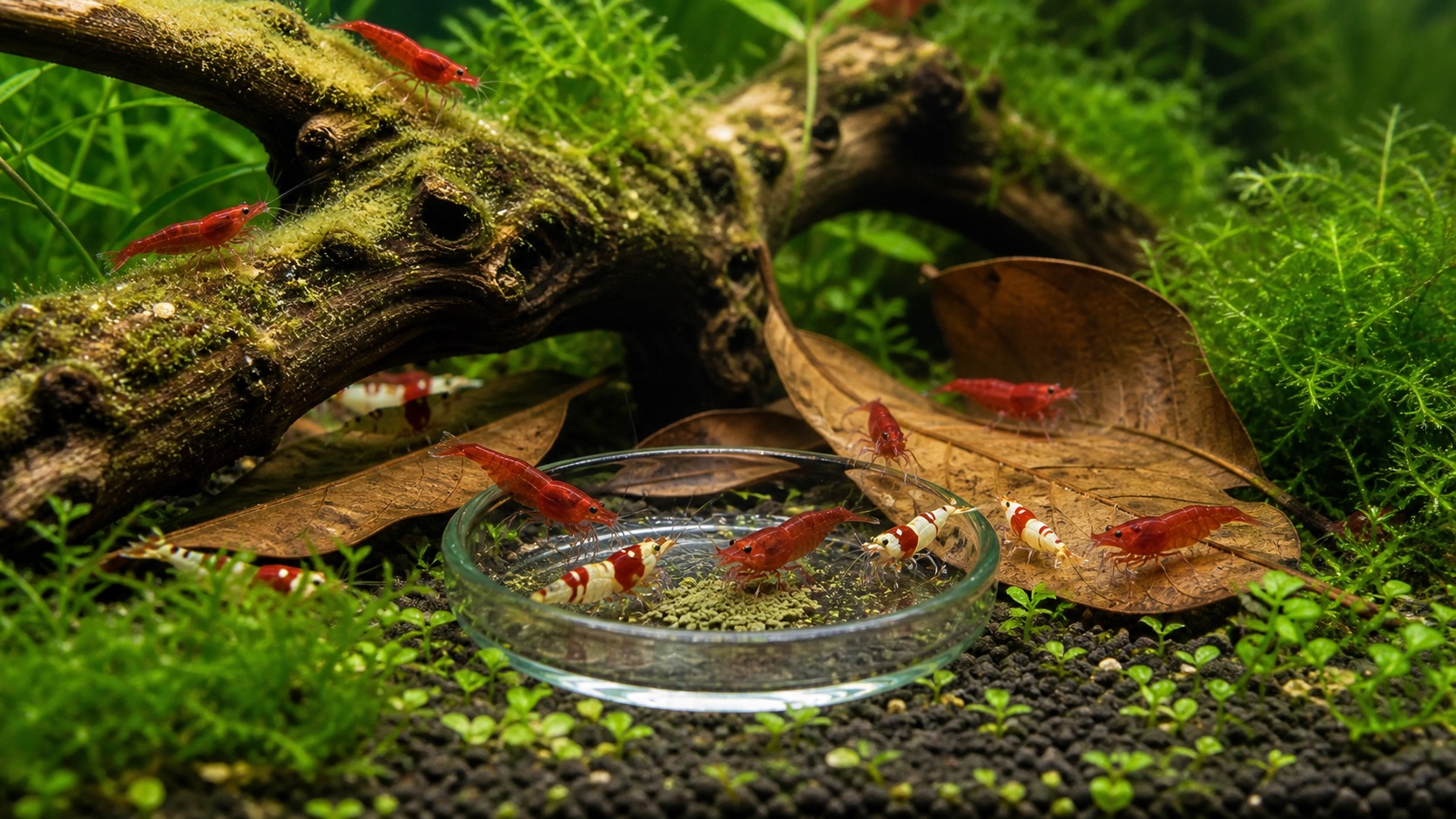
Feeding aquarium shrimp: complete guide to food, biofilm and growth
Learn how to feed shrimp safely: biofilm, staple food, leaves, vegetables, minerals, protein, shrimplets, overfeeding and species-specific plans.
Written by
- Published
- Updated
- Reading time
- 4 min read
Feeding shrimp is not just dropping food into a nano tank. Nutrition controls growth, breeding, molting and water quality. Too little usable food gives slow growth and weak shrimplet survival. Too much food creates bacterial load, low oxygen, ammonia and nitrite risk. The best feeding plan starts with a mature tank full of biofilm, then adds small, controlled portions.
This guide explains what shrimp eat, how often to feed, how to size portions, how biofilm supports juveniles, how to use leaves and vegetables, when minerals and protein help, and how to recognize overfeeding before it kills animals.
The feeding principle
Dwarf shrimp are grazers and scavengers. They scrape biofilm, algae film, microorganisms, plant matter and fine particles from surfaces. Commercial food is useful, but it should supplement the tank, not replace maturity. A sterile tank with heavy pellets is worse than a mature tank with many surfaces and small meals.
| Food source | Purpose | Risk | Use |
|---|---|---|---|
| Biofilm | Daily grazing | Too little in young tanks | Leaves, moss, wood, sponge, time |
| Staple food | Controlled nutrition | Leftovers | Small portions and removal |
| Leaves | Biofilm and shelter | Organic overload | Add slowly |
| Vegetables | Variation | Rotting | Short sessions |
| Protein food | Growth and eggs | Bacterial bloom | Small and occasional |
| Mineral food | Molting support | False fix for bad water | Use with correct GH and stability |
How often should shrimp be fed?
A small group in a mature planted tank may only need two to four tiny meals per week. A dense breeding colony with many shrimplets may need more frequent micro portions. A young tank, hot tank, tank with deaths, ammonia or nitrite should be fed less or not at all until stable.
Behavior is the control. Healthy shrimp find food quickly, but they should also graze all day. Food left after two to three hours is usually too much.
Biofilm, leaves and vegetables
Biofilm is a layer of bacteria, algae, fungi, microorganisms and organic material on surfaces. Shrimp graze it constantly, and shrimplets depend on it because they do not travel far for large pellets. Moss, sponge filters, wood, leaves and porous rock create feeding surfaces.
Catappa, oak, beech leaves and alder cones can support biofilm and grazing, but add them slowly. Vegetables such as zucchini, spinach, nettle or cucumber are short snacks, not staple food. Remove leftovers before they rot.
Staple food, powder and shrimplets
Good staple food sinks, holds together long enough to be grazed and does not cloud the water. Powder food can help shrimplets, but it is easy to overdose because it spreads through the whole tank. Use it only in tiny amounts in mature tanks with reliable filtration.
Shrimplets need local food. They graze near their hiding places on moss, sponge, leaves and biofilm. If many babies disappear, check predation, filter intake safety, maturity, food distribution and water quality.
Minerals, protein and molting
Molting depends on stable water and nutrition. Calcium and magnesium should mainly come through suitable GH and mineralization. Mineral foods can support, but they do not fix wrong water, exhausted soil or large TDS swings. Protein supports growth and eggs, but heavy protein feeding can fuel bacteria and oxygen problems.
Overfeeding and species differences
Overfeeding shows as leftovers, cloudy water, slimy surfaces, smell, oxygen stress, snail booms, rising nitrate and sometimes ammonia or nitrite. Remove food, stop feeding for a few days, increase aeration, test water and restart with smaller portions.
Neocaridina are flexible grazers. Bee Caridina need smaller clean portions in soft systems. Sulawesi tanks require mature surfaces, warmth, oxygen and very careful feeding. Amano shrimp eat algae but still need complete food. Filter shrimp need fine suspended food in flow and should not be forced to scrape the bottom.
Practical plan
- Build biofilm with mature surfaces before relying on food.
- Start with tiny staple portions two to four times per week.
- Use a feeding dish or fixed spot.
- Remove food that remains after a few hours.
- Add leaves slowly and treat vegetables as short snacks.
- Use powder and protein food sparingly.
- Feed less during heat, deaths, medication, ammonia or nitrite.
Feeding FAQ
Should shrimp be fed every day?
Not always. A small group in a mature tank often does well with a few small feedings per week.
Can shrimp live on algae?
They graze algae film and biofilm, but stable colonies usually need more variety than visible algae alone.
Why do shrimp die after feeding?
Common causes are overfeeding, oxygen loss, ammonia, nitrite or spoiled food. Test water and remove leftovers.
Does mineral food fix molting?
It can support, but stable GH, KH, TDS, temperature and water changes are the base.
Sources and review
Last content review: 31 October 2025.