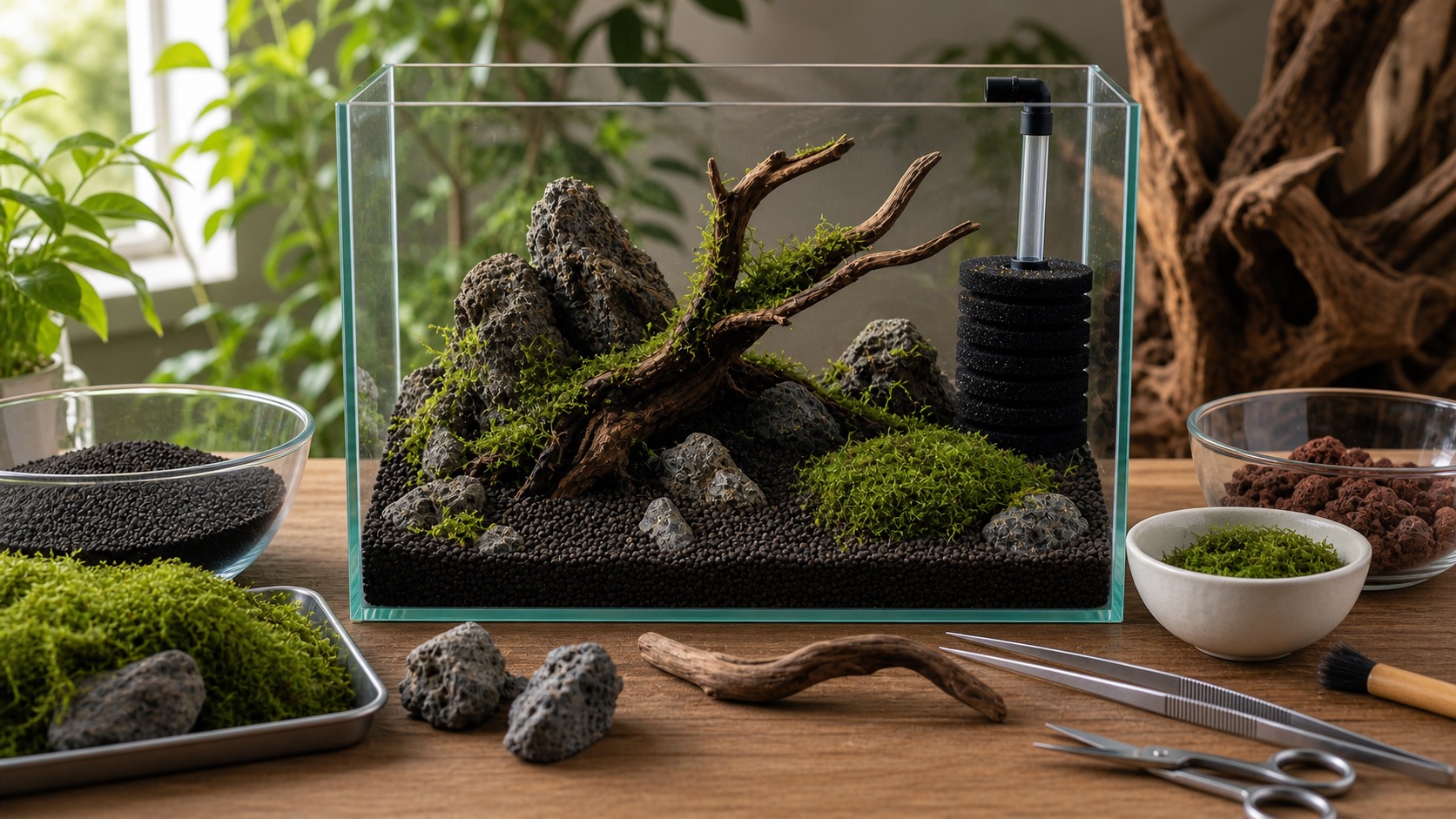
Setting up a shrimp aquarium: the complete safe tank guide
Build a stable, shrimp-safe and breeding-focused aquarium: tank size, filter, substrate, hardscape, plants, cycling and biofilm.
Written by
- Published
- Updated
- Reading time
- 4 min read
A good shrimp aquarium is not just a small fish tank with shrimp added. It is a system with lots of surface, safe filtration, calm water, stable minerals and enough biofilm. The layout determines whether shrimplets find food, molts happen calmly and small mistakes are buffered. A beautiful aquascape is only shrimp-safe when it also works biologically.
This guide helps you design a shrimp tank from zero. Choose the species group and water strategy first. Then choose substrate, filter, rocks, wood, plants and maintenance route.
Start with the tank goal
A beginner Neocaridina tank, a Crystal Red breeding tank, a Sulawesi system, an Amano community tank and a filter-shrimp tank do not need the same layout. Neocaridina often benefit from inert substrate, measurable KH and lots of biofilm. Bee Caridina often use active soil and RO water with GH+. Sulawesi needs warm alkaline water, oxygen and a very mature tank. Filter shrimp need flow and fine food in the water column.
| Tank goal | Substrate | Filter | Main focus | Avoid |
|---|---|---|---|---|
| Neocaridina beginner | Inert gravel or sand | Sponge filter or prefilter | Stability, biofilm, measurable KH | Active soil without a plan |
| Bee Caridina | Active soil | Sponge or gentle filter | Low KH, RO with GH+, calm changes | Limestone and GH/KH+ without reason |
| Sulawesi | Inert and clean | Oxygen-rich and reliable | Heat, pH, oxygen, maturity | Young sterile tanks |
| Amano or community | Inert or planned plant substrate | Protected intake | Cover, lid, water quality | Predators and open intakes |
| Filter shrimp | Inert with perches | Flow plus oxygen | Food current and resting spots | Small still nano tanks |
Tank size and location
For beginners, 30 to 40 liters is usually easier than 10 to 20 liters. Small tanks can work, but temperature, TDS, nitrate and feeding load move faster. Choose a place without direct sun, heat spikes or weak furniture. Leave enough room for water changes and filter access.
Filter and oxygen
A sponge filter is often the best shrimp base. It has surface area, gentle flow, oxygen and no dangerous intake for shrimplets. Canister and hang-on filters can work, but use a fine prefilter sponge. Biological surface matters more than strong flow. Oxygen becomes critical with heat, heavy feeding, medication, bacterial bloom or Sulawesi tanks.
Do not clean the filter sterile. Rinse sponge or media only when flow drops, using removed aquarium water. Never replace all media at once.
Substrate, hardscape and plants
For Neocaridina, inert gravel or sand is usually predictable. For many Bee Caridina, active soil helps lower KH and guide pH, but it works best with RO water and the right minerals. Sulawesi should not be placed on acidic active soil. Rocks, wood and leaves add biofilm surface and cover, but calcareous rock can raise GH, KH and pH.
Moss, Java fern, Anubias, Bucephalandra, floating plants and easy stems add surface and nutrient uptake. A low-tech planted tank is often safer than a high-CO2 setup with large pH swings. Biofilm on glass, sponge, wood, leaves and moss is a food base, not dirt.
Cycling and maturity
Cycling means the tank can process ammonia and nitrite. Maturity means surfaces, plants, filter, substrate and micro-life become stable. Shrimp need both. Ammonia and nitrite must be zero, but a newly cycled bare tank is not ideal for shrimp.
Use a fishless cycle or controlled start without animals. Add shrimp only when the tank processes waste reliably and values match the species. Extra time with moss, leaves and a light biofilm food source helps shrimplets later.
Design for easy maintenance
Leave space for a feeding dish, filter access, a spot to siphon debris and open substrate to observe shrimp. Do not build hardscape that hides every dead zone. Plan water changes before animals go in: where the bucket goes, how temperature is matched and where new water enters slowly.
Example setups
Simple Neocaridina tank
30 to 45 liters, inert substrate, sponge filter, moss, Java fern or Anubias, cholla wood, leaves, calm light and suitable tap water.
Crystal Red or Taiwan Bee tank
30 to 60 liters, active soil, RO water with GH+, low KH, sponge or undergravel filter, moss and few fast changes.
Sulawesi tank
Specific minerals, warm water, high oxygen, inert hardscape, mature filter and careful feeding.
Filter-shrimp tank
Larger aquarium with flow, perches in the current, oxygen, fine food and calm tank mates.
Setup FAQ
What is the best substrate for shrimp?
For Neocaridina, usually inert substrate. For many Bee Caridina, active soil with RO water and GH+. The species decides.
Is a sponge filter enough?
Yes for many shrimp tanks. In larger or heavily stocked tanks, extra filtration can help if intakes are safe.
Does a shrimp tank need many plants?
Plants and moss help, but stable water, biofilm and cover matter more than a high-tech planted system.
How long should a shrimp tank cycle?
Until ammonia and nitrite are reliably zero and the tank is biologically stable. Extra biofilm maturity is strongly recommended.
Can I use rocks from nature?
Only if they are clean, safe and suitable for your water. Avoid unknown pollution, metals and limestone in soft Caridina systems.
Sources and review
Last content review: 16 September 2025.