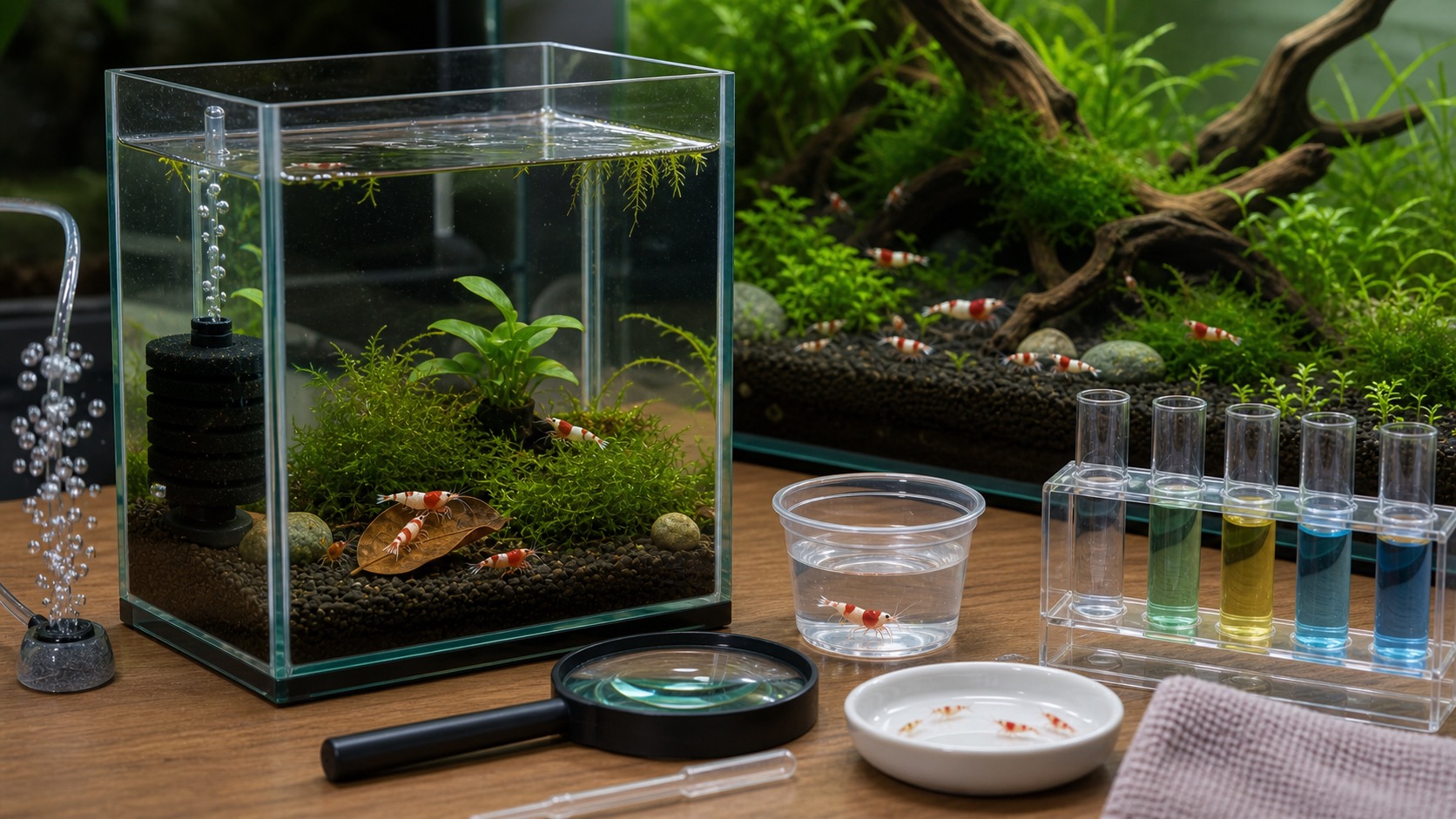
Shrimp health and diseases: complete diagnosis and first aid guide
Learn how to recognize sick shrimp and act safely: water quality, oxygen, toxins, molting, parasites, bacterial issues, quarantine and emergency triage.
Written by
- Published
- Updated
- Reading time
- 3 min read
Shrimp health problems are often blamed on disease too quickly. Most losses start with water quality, oxygen, toxins, poor acclimation, overfeeding, unstable minerals or an immature tank. Parasites and bacterial problems exist, but treatment without diagnosis can weaken the colony further.
This guide uses a triage approach: decide whether behavior is normal, stress, molting or acute loss. Then check water, oxygen, temperature, TDS, recent changes and toxins before looking at visible issues such as vorticella, scutariella, green growth, shell lesions or bacterial signs.
Normal behavior or warning sign?
Healthy shrimp graze, balance well, respond to food and molt without prolonged collapse. Hiding after transport, molting, rescape or fish pressure can be normal. Stronger alarms are several shrimp acting strangely at once, climbing to the surface, falling over, losing balance, showing a milky body, dying after a water change or gathering at the filter outflow.
| Sign | Check first | Reason |
|---|---|---|
| Many deaths fast | Ammonia, nitrite, oxygen, toxins | Sudden colony loss is usually environmental first |
| Deaths after water change | Temperature, TDS, pH, chlorine, copper | Shock and toxins act quickly |
| White ring or failed molt | GH, KH, TDS, feeding, routine | Molting depends on minerals and stability |
| White fuzzy growth | Vorticella or similar epibionts | Visible issues need correct recognition |
| Small white worms on head | Scutariella or similar epibionts | Often introduced with new animals |
First aid for deaths
Remove dead animals, stop feeding, increase aeration and test ammonia, nitrite, nitrate, pH, GH, KH, TDS and temperature. Review the last 72 hours: water change, new food, plants, medication, cleaning spray, insect spray, metals, stones, new animals or filter cleaning.
Any ammonia or nitrite is urgent. Increase oxygen and use controlled water changes with matching prepared water. If chlorine, copper, pesticide or medication is suspected, use only shrimp-safe conditioner or carbon and avoid shock from large mismatched changes.
Water, toxins and molting
Many health problems cannot be fixed with medication because the cause is the system. Ammonia is more dangerous at higher pH and temperature. Nitrite and low oxygen stress shrimp quickly. Copper, fish medication, algae killers, snail treatments, pesticide residues and household sprays can harm invertebrates. Never use a fish product unless it is clearly safe for shrimp.
Failed molts are common. The white ring is a warning sign, not a full diagnosis. Check GH, KH, TDS, temperature, feeding, age, stress and how quickly water changes. Random minerals do not fix every molt problem; the species and water strategy decide the correct range.
Visible parasites and growths
Vorticella can look like white fuzzy or fan-like growth on the head, rostrum or legs. Scutariella often appears as small white worms around the head or gill area. Green fungal-looking growth under the body is difficult to diagnose from photos and should be handled by reducing spread and isolating affected animals.
Treat visible conditions cautiously and preferably outside the main tank. Quarantine, removing molts that may carry eggs, improving water quality and lowering pathogen pressure are often safer than medicating the whole aquarium.
Bacterial issues, quarantine and medication
Bacterial issues are hard to confirm without lab work. Milky body, lethargy, shell spots, erosion, rapid deaths or stopped grazing can have multiple causes. Improve conditions first: remove food, reduce feeding, remove dead animals, increase oxygen, stabilize water and isolate suspicious animals if that reduces risk.
Prevention beats treatment. Quarantine new shrimp, avoid tanks with dead animals, rinse plants, avoid unknown pesticides and do not share nets or hoses between sick and healthy tanks. Medication, salt dips and whole-tank treatments should be used only with a clear target and shrimp-safe evidence.
Triage checklist
- Remove dead animals and stop feeding.
- Increase oxygen.
- Test ammonia, nitrite, nitrate, pH, GH, KH, TDS and temperature.
- Review changes in the last 72 hours.
- Correct measurable water problems with matching water.
- Only then identify visible parasites, growths or bacterial signs.
- Use quarantine before whole-tank treatment when possible.
Sources and review
Last content review: 29 January 2026.
- The Shrimp Farm: Diagnosing shrimp disease
- The Shrimp Farm: Vorticella and shrimp
- The Shrimp Farm: Failed molting in shrimp
- University of Florida IFAS: Ammonia in Aquatic Systems
- US EPA: Aquatic Life Criteria for Copper
- Merck Veterinary Manual: Bacterial diseases in aquaculture
- Fisheries and Oceans Canada: Shell Disease