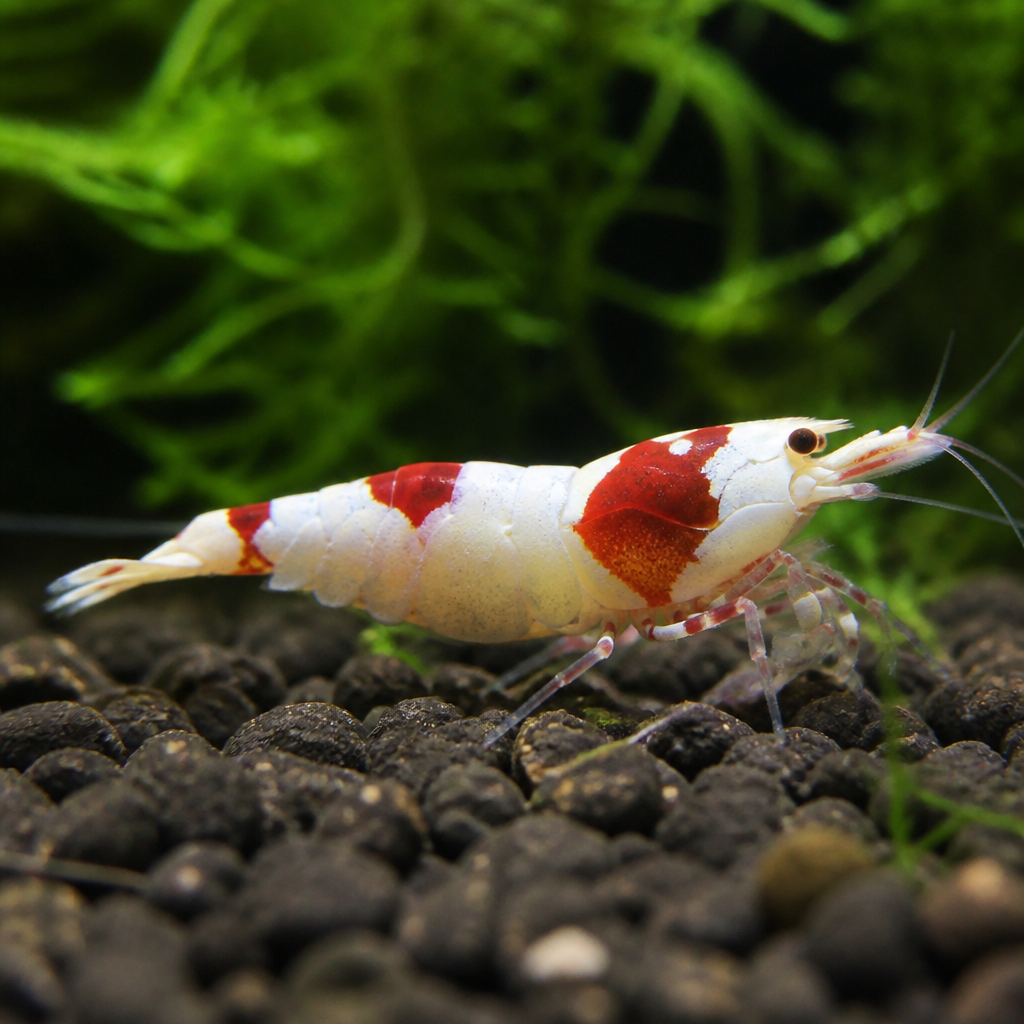
Quick care card
Use this card as a starting point. Always check whether your aquarium is stable enough for sensitive species.
Difficulty
Difficult
Behavior
Grazes surfaces and uses shelter.
Feeding
Suitable food and grazing space, accessible to juveniles too.
Breeding
Follow young actually growing; pattern inheritance depends on the strain.
Best match
Keepers able to follow a soft-water system and their chosen strain
Important
A pattern or high price does not establish health. During losses or sudden changes in behaviour, first investigate water quality, oxygen provision and recent additions.
Care in practice
Prepare a measurable soft-water system and compare the offered strain with bee husbandry guidance. Ask about temperature, GH, KH, pH, source water and substrate. RO with appropriate minerals may help where tap water does not fit; follow the actual substrate and mineral instructions. TDS or a trade name alone is insufficient.
Background and identification
Which markings are you buying?
| Label | What to compare |
|---|---|
| Pinto | Contrasting head and body markings, with several possible patterns. |
| Red Pinto | Red expression of the pattern with pale markings. |
| Galaxy Pinto | Often head spots combined with a Pinto pattern. |
| Zebra / Fishbone | Transverse bands; Fishbone also has a pale dorsal line. |
These descriptions help comparisons, but sellers may draw different boundaries. MADSHRIMP provides a breeder classification. Garnelen-Pott, for example, offers Galaxy Pinto from a Boa strain: the labels do not always exclude one another. Record head spots, dorsal pattern, coverage and origin of the actual group.
A promised percentage of Pinto offspring requires records of the parents and several broods. Without these, a fixed percentage is speculation. Ask what variation the breeder actually observes and plan housing for differently marked offspring too. The same soft-water basis may suit different patterns; do not alter the system just because an animal has more spots.
For overlap with cape and strongly branched patterns, compare Boa and Galaxy Boa.
For aquarium preparation, use a manageable bee water system. The water decision guide connects source water, GH, KH, substrate and water changes.
Sources and review
Sources for accepted names, classification and synonyms.
- Garnelenhaus: Taiwan Bee / Shadow Bee
Hobby descriptions of hybrid lines, trade patterns and low-KH husbandry. Claimed 100 percent inheritance, pigment mechanisms and universal hybrid outcomes are not adopted.
Sources for water values, temperature and stable care.
- Garnelenhaus: Bienengarnele
Hobby husbandry of bee shrimp and soft-water systems. Broad published ranges are not experimental optima; unsupported feeding-frequency and crossbreeding guarantees are not adopted.
Practical sources for setup, feeding, behavior and breeding.
- Garnelenhaus: Taiwan Bee / Shadow Bee
Hobby descriptions of hybrid lines, trade patterns and low-KH husbandry. Claimed 100 percent inheritance, pigment mechanisms and universal hybrid outcomes are not adopted.
- Ethan at MADSHRIMP: Stardust classification, part 2
Breeder observations and photographs explaining Galaxy spots, zebra, fishbone, cape and Boa pattern combinations. One breeder classification, not an official grading standard or a health measure.
- Garnelen-Pott: Galaxy Pinto from a Boa strain
A breeder seller describing its own offered animals and variation. Evidence that these trade labels can overlap, not a scientific definition of Boa genes or general husbandry authority.