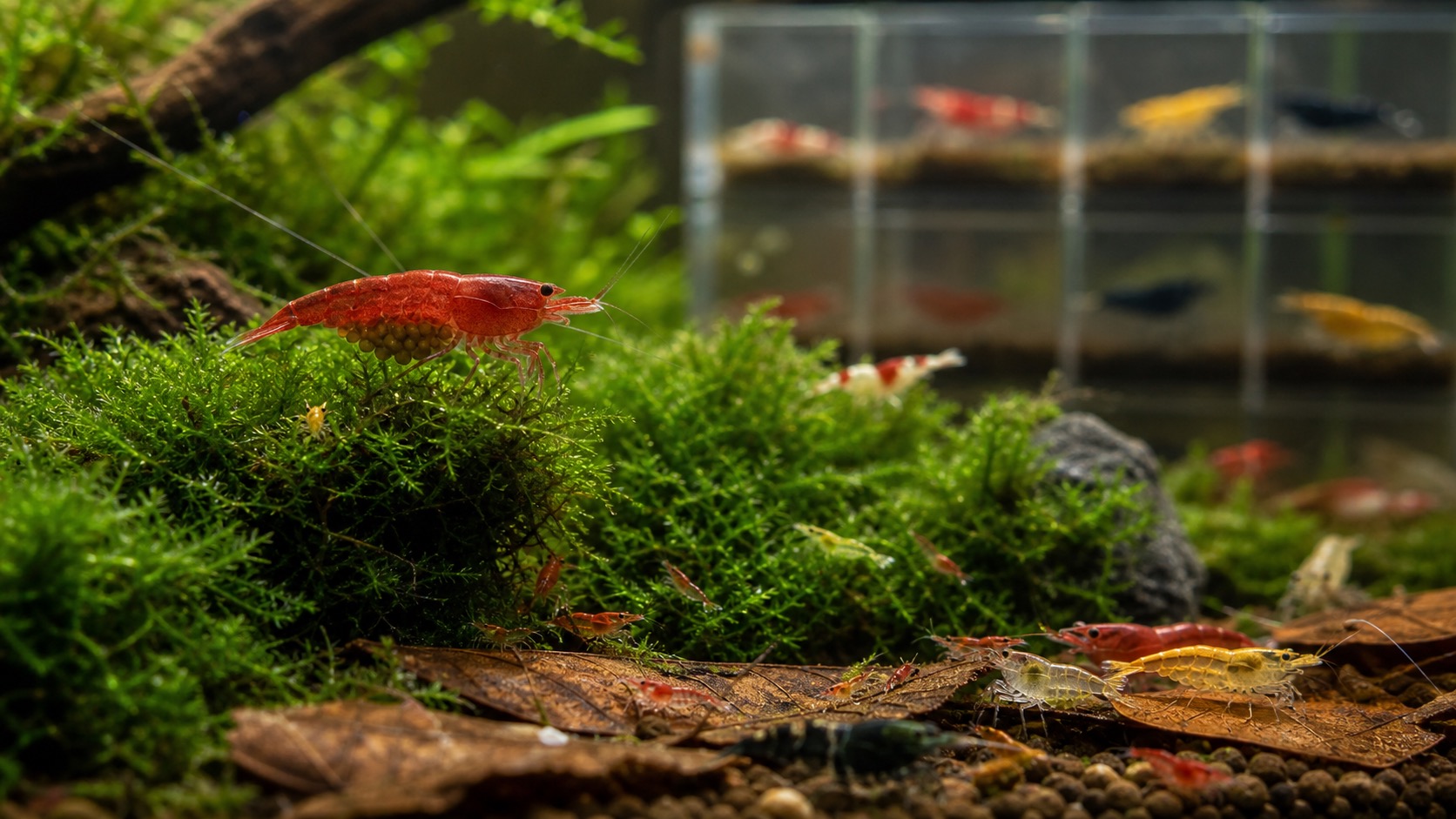
Aquarium shrimp breeding guide: from first colony to stable color line
A practical route from a mature breeding tank and healthy starter group to berried females, surviving shrimplets and documented color lines.
Written by
- Published
- Updated
- Reading time
- 8 min read
Quick answer
Successful shrimp breeding starts with a stable, mature species tank—not with a genetics chart. Match the water to the shrimp, start with enough unrelated healthy animals, make every filter intake shrimplet-safe and protect mature grazing surfaces. Once babies survive consistently, you can select for color or pattern and record results over several generations.
This guide follows the order that produces useful results: breeding readiness, reproduction, baby-shrimp survival and only then selective breeding. It focuses on freshwater dwarf shrimp such as Neocaridina davidi and bee-type Caridina. Amano and Sulawesi shrimp are separated where their biology or husbandry changes the plan.
1. Decide what you are trying to breed
A healthy colony and a stable color line are related but different goals. A colony goal is regular reproduction, good survival and a wide enough genetic base. A line-breeding goal adds deliberate selection, separation and records. Do not narrow the breeding group for color while the colony still has unexplained deaths, poor molts or low fertility.
| Goal | First priority | What success looks like |
|---|---|---|
| Healthy colony | Stable species-appropriate water and low stress | Multiple females carry eggs and young reach adulthood |
| More shrimplets | Biofilm, filter safety and protection from fish | Small juveniles remain visible between molts |
| Color or pattern line | Repeatable selection plus records | The chosen trait appears consistently across generations |
| Crossing project | Separate test tank and honest labels | Parents and every generation remain traceable |
2. Check whether the tank is ready
A cycled aquarium is not automatically a breeding aquarium. Nitrification can control ammonia while glass, wood, moss and filter sponge still have little mature biofilm. Young shrimp spend much of their time on local surfaces, so a spotless new setup offers less margin than an established one.
- Ammonia and nitrite remain at zero during the normal feeding routine.
- Temperature, pH, GH, KH and TDS are stable and suit the exact shrimp group.
- The filter has no opening that can trap a newly hatched shrimp.
- Moss, wood, leaves, sponge or other textured surfaces carry visible grazing growth.
- Water changes use prepared water with closely matched temperature and mineral concentration.
- There is no recent unexplained death, mass hiding or failed-molt pattern.
Build the system with the breeding-tank layout, then use the biofilm guide to mature useful surfaces without deliberately fouling the water.
3. Start with the right group
For a first Neocaridina or bee-Caridina project, a group of roughly 10–20 juveniles or young adults normally gives better sex odds and a broader starting base than buying one obvious pair. Buy one clearly named species or compatible line from a breeder who can share the water values and origin. Quarantine new animals before they join an established breeding group.
Do not judge sex reliably in very young shrimp. Adult females are often larger and deeper-bodied; a visible saddle or carried eggs is stronger evidence than color alone. The starter-group guide explains the trade-off, and the sexing guide shows which signs are useful.
4. Know which life cycle you are working with
| Shrimp group | Young at hatch | Breeding implication |
|---|---|---|
| Neocaridina | Miniature benthic shrimp | Direct development makes a mature freshwater species tank the practical beginner route |
| Bee-type Caridina | Miniature benthic shrimp | Direct development, but soft-water lines need more precise mineral and substrate management |
| Amano shrimp | Free-swimming larvae | Adults reproduce in freshwater, but larval rearing needs a separate saline plan |
| Sulawesi shrimp | Species-dependent direct-development projects | Warm, alkaline, highly oxygenated systems require specialist preparation |
Do not transfer an Amano method to Cherry shrimp or a Neocaridina water recipe to Crystal Red shrimp. For a first breeding project, follow the step-by-step freshwater route. Treat Amano larval rearing and Sulawesi breeding as separate projects.
5. Understand the breeding sequence
- Saddle: developing eggs may become visible behind the head of a mature female.
- Molt and mating: a receptive female molts; males may swim actively while following chemical cues.
- Berried stage: fertilized eggs are carried under the abdomen and ventilated with the swimmerets.
- Hatch: direct-developing Neocaridina and many Caridina release tiny formed shrimp onto surfaces.
- Juvenile growth: young shrimp graze locally, molt repeatedly and gradually use more of the tank.
Use the sequence, not an exact calendar, to judge progress. Temperature, species, age and condition change timing. Avoid moving a berried female unless the current tank is unsafe; catching and transferring her can add more risk than leaving her in a prepared aquarium. See the berried-shrimp care guide for the low-intervention approach.
6. Make baby-shrimp survival the main metric
Seeing eggs proves mating occurred. Seeing juveniles several weeks later proves the system supports them. The biggest gains usually come from habitat and risk control rather than from adding more powdered food.
- Cover every intake with fine sponge and inspect gaps after maintenance.
- Keep mature moss, leaf surfaces, wood and filter sponge available for grazing.
- Prefer a species tank when production matters; even small fish can remove many shrimplets.
- Feed tiny amounts only when the tank's natural grazing cannot support the colony.
- Keep oxygen and filter flow steady, especially in warm weather.
- Change water gently with matched water instead of making abrupt corrections.
Fine food spreads widely, which can help juveniles reach it, but the same property makes overdosing easy. If food coats the substrate, clouds the water or remains uneaten, reduce it. Use the full baby-shrimp survival checklist before buying another product.
7. Troubleshoot in the right order
| What you see | Check first | Do not assume |
|---|---|---|
| No berried females | Adult sex ratio, maturity, temperature, food and chronic stress | That one additive will trigger breeding |
| Eggs disappear early | Young females, stress, water changes, failed fertilization and health | That every lost clutch means disease |
| Babies appear, then vanish | Filter intake, fish, biofilm, oxygen and food distribution | That adults ate all young |
| Poor molts or deaths | Ammonia, nitrite, oxygen, temperature and sudden GH/TDS change | That more minerals are automatically the answer |
| Color declines | Mixed ancestry, selection records, age, sex, stress and lighting | That a simple color chart predicts every offspring |
Stop selecting, crossing or adding animals while the colony has deaths or poor molts. Stabilize welfare first. Changing food, minerals, substrate and water schedule together hides the cause and can create a second problem.
8. Move from colony breeding to line breeding
Once the colony produces healthy adults reliably, define one trait you can observe consistently: color coverage, intensity, transparency, stripe, pattern or another clear phenotype. Health, fertility, body form and normal behavior remain non-negotiable. A striking animal that breeds poorly should not outrank a healthy breeder solely because of appearance.
Shrimp color is not a guaranteed one-gene formula. Line history and inherited traits matter, but age, sex, health, food, stress, lighting and substrate can change what you see. Treat commercial grade and color names as descriptions, not universal biological standards. The shrimp color-genetics guide separates observation from oversimplified charts.
A practical three-generation selection cycle
- Foundation: photograph the original group, record seller, water and claimed line, and allow it to reproduce without selecting juveniles too early.
- First offspring: compare mature siblings under the same conditions. Move clearly off-target animals out of the breeding group while preserving welfare.
- Second offspring: repeat the same written criteria. Note how many young express the target instead of remembering only the best individual.
- Third offspring and beyond: call the line more stable only when the chosen trait repeats at a useful rate without sacrificing fertility, survival or body quality.
A single exceptional juvenile is not a stable line. Stability is a population result observed across generations. Use the longer stable color-line plan when you are ready to split groups.
9. Keep a breeding log you can actually use
Give each tank and line a fixed code. Record changes when they happen; reconstructing parentage months later is unreliable.
| Record | Useful detail |
|---|---|
| Origin | Seller or breeder, date, line name, number and photos |
| System | Tank code, substrate, water source, minerals and normal parameter range |
| Breeding event | First saddled and berried dates, hatch window and estimated juvenile count |
| Selection | Trait, age judged, animals retained and animals moved |
| Outcome | Survival, fertility, molt issues and proportion showing the target trait |
The breeding-log template provides a reusable structure. Photograph shrimp under similar light and at a similar age; otherwise lighting and development can look like genetic progress.
10. Manage culls, inbreeding and new blood responsibly
In shrimp keeping, “culling” usually means removing an animal from the selected breeding group. It does not have to mean killing it. A healthy off-pattern shrimp can live in a separate mixed display, be rehomed or be sold with an honest description. Never release aquarium animals into natural water.
Closed lines can become more uniform, but small repeated breeding groups can also lose vigor. Watch outcomes—fertility, hatch success, growth, body form and unexplained losses—rather than assuming every closed line is either safe or doomed. If you add new blood, quarantine it, verify species compatibility and test the cross in a separate group. New animals can improve diversity while also changing the selected phenotype or introducing pathogens. Read the inbreeding guide before merging valuable lines.
Frequently asked questions
How long does it take aquarium shrimp to breed?
There is no dependable single number. The animals must first mature and acclimate; after mating, egg development also varies with species and temperature. Judge the sequence—saddle, molt, carried eggs, hatch and juvenile growth—rather than forcing a deadline.
How many shrimp should I start a breeding colony with?
Roughly 10–20 healthy juveniles or young adults is a practical first group for common dwarf shrimp. It improves sex odds and the genetic base compared with one pair, while remaining manageable in a mature tank.
Can shrimp breed in a community tank?
Adults may reproduce, but shrimplet survival is usually lower when fish can reach them. Dense cover helps but does not make predation disappear. Use a species tank when producing young is the main goal.
Do I need special food for baby shrimp?
Not automatically. Mature biofilm and safe grazing surfaces are the foundation. Fine supplemental food can help in a growing colony, but excess powder can degrade water quality quickly.
Can I mix different Neocaridina colors?
You can keep them together, but do not expect every offspring to retain the parents' sale colors. Mixed ancestry can produce varied or wild-type-looking young. Keep lines separate when stable color is the goal.
Sources and review
Last content review: July 15, 2026.
- University of Florida IFAS: Cherry shrimp biology, direct development and culture
- FAO AGRIS: Biofilm-based Neocaridina culture, growth and reproduction
- University of Florida IFAS: Basic aquaculture water quality
- USGS NAS: Neocaridina davidi species profile
- Peer-reviewed study: Neocaridina color morphs and preference
- Flanders animal information: Freshwater shrimp welfare and care