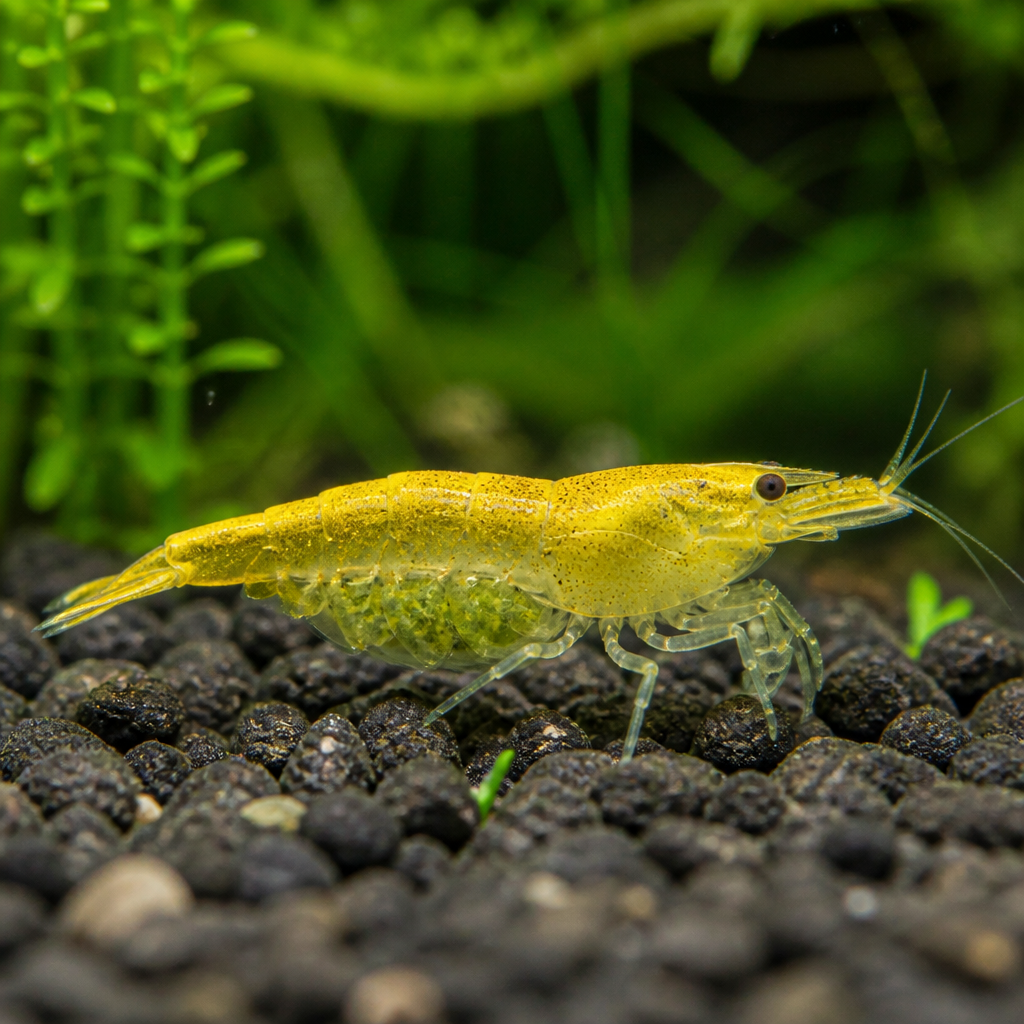
Quick care card
Use this card as a starting point. Always check whether your aquarium is stable enough for sensitive species.
Difficulty
Easy
Behavior
Grazes surfaces; shelter remains necessary.
Feeding
Check added food and food on grazing surfaces.
Breeding
Freshwater development; colour consistency is not guaranteed.
Best match
Keepers able to follow the selected strain and colony
Important
Colour is not a health test. During sudden behavioural change or losses, first check water quality, oxygen provision and recent additions.
Care in practice
The colour form has no separately established water recipe. Use supported Neocaridina husbandry guidance and compare conditions with the offered stock. A trade name or colour grade does not establish extra tolerance.
Background and identification
Assess body colour and dorsal stripe separately
The previous profiles both described a yellow body with a brighter stripe along the back. The names do not establish different care. Ask whether males also show the stripe and what the offered group’s young look like. Ulli Bauer describes this feature in many Yellow Fire Neon males, so it is not a certain sex test.
Compare under the same light. “Golden” does not make an animal healthier or genetically purer. Keeping a yellow strain separately helps follow offspring but promises no fixed colour outcome. Buy on information about the group, not an asserted extra water or dietary need for the stripe.
For full care, use the Neocaridina davidi profile. Check water, filtration, food access and space for the colony before buying.
Sources and review
Sources for accepted names, classification and synonyms.
- UF/IFAS: Cherry shrimp, Neocaridina davidi
Identity, direct freshwater development, grazing and colour forms; laboratory timing is not promised for every aquarium.
Sources for water values, temperature and stable care.
- Aquarium Co-Op: Cherry shrimp care
Own husbandry guidance and tankmate experience. Its 22-24 C, pH 6.5-8.5, GH at least 6 and KH at least 2 are attributed practice guidance, not experimentally proven universal safe limits. No guaranteed sex ratio, mandatory mineral addition or fish safety adopted.
Practical sources for setup, feeding, behavior and breeding.
- Ulli Bauer: Yellow Fire Neon
Description and own photographs of yellow colour and conspicuous dorsal stripe, including males. No guaranteed offspring colour or universal stock identification adopted.
- Garnelenhaus: Neocaridina colour lines and reported crosses
Named hobby breeding observations, including variable offspring. No universal Mendelian ratios, guaranteed line purity or certainty of mixed-species ancestry adopted.