Quick care card
Use this card as a starting point. Always check whether your aquarium is stable enough for sensitive species.
Difficulty
Expert
Behavior
Rock dweller that uses shelter between stones.
Feeding
Accessible grazing surfaces and monitored supplementary food.
Breeding
Assess actual juvenile growth; eggs do not guarantee a lasting colony.
Best match
Keepers able to substantiate identity, warm-water management and food access for each group
Important
A Harlequin trade name does not guarantee species identity. Do not treat one precise habitat reading or a general Sulawesi range as a proven safe limit.
Care in practice
Prepare a suitable warm, alkaline system with information about the actual group. The consulted species description supplies no tested safe aquarium range. Follow product instructions to mix minerals outside the tank and check GH, KH, pH, temperature and conductivity together. Do not fill unknown limits with a single Towuti habitat reading.
Retain rock surfaces, crevices and accessible grazing and maintenance locations. The scientific account records rocks in shallow and deeper parts of Towuti. This supports a rock-based layout, not a mandatory minimum volume or months of waiting. Assess filtration, grazing space and food before stocking.
Check uptake of suitable fine food on occupied surfaces. A green rock does not establish complete nutrition. Distribute small, accountable additions where animals occur and assess leftovers and water quality. Do not withhold necessary food because generic Sulawesi advice says only to feed sparingly.
Observe quietly without repeatedly lifting rocks. Disturbed animals may retreat along or beneath them. Record behaviour, counts and changes; absence from view does not automatically establish death or good condition. Match the group to available living space and food.
A separate species group aids identification and observation. Sharing a lake does not establish that a small mixed aquarium offers adequate food and space. Fish add predation risk. Combine only when all requirements fit and separation is workable.
The original revision records egg-carrying females. This supports reproductive information but does not predict a fixed aquarium yield per female. For captive-breeding claims, ask about followed juveniles and the full method. Protect intakes and food access; do not add salt based on an Amano breeding recipe.
Confusing it with C. spongicola or marine Harlequin; presenting habitat readings as guarantees; confusing cleaning with food shortage; sticking to a small fixed change despite pollution; combining by island name.
Background and identification
The revision identifies Caridina woltereckae as endemic to Lake Towuti, Sulawesi, on hard substrate. Sulawesi Keepers lists this Harlequin among threatened lake fauna. Choose documented origin and ask about substantiated captive breeding.
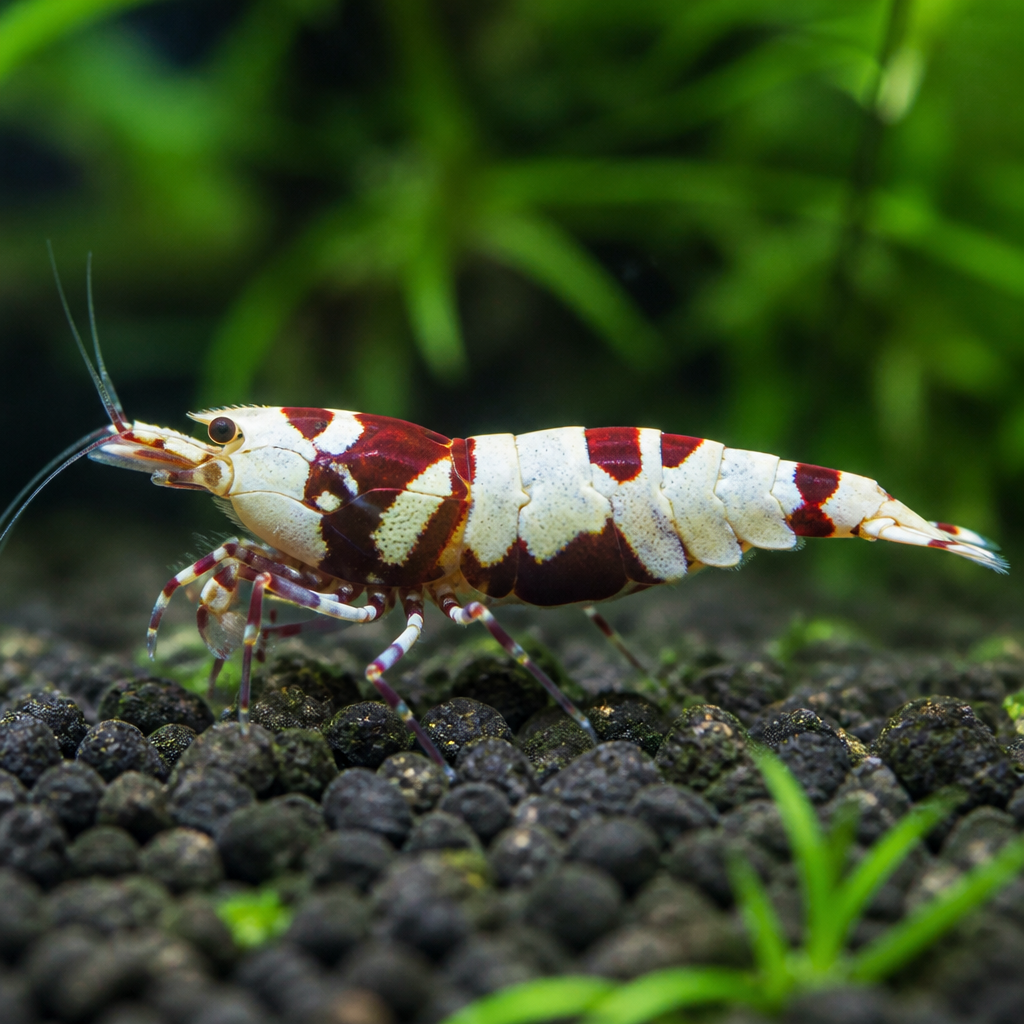
The species description records dark transverse bands, a white belt at the rear of the carapace, a white lateral stripe and conspicuously white parts of the first two leg pairs. The pattern can resemble C. spongicola. A sales photograph alone is not conclusive identification.
C. woltereckae is a more widely distributed Towuti rock dweller; similar-looking C. spongicola is associated with freshwater sponges in the outlet bay. Cardinal from Matano has white spots on red rather than this banded pattern. Do not use habitat alone to assign a name to unknown commercial stock.
Identification comes before a care recipe
A red-and-white banded photograph alone may not reliably identify the offered group. Ask for scientific name, origin and the conditions used for adults and any juveniles. The marine Harlequin in Hymenocera is a different shrimp entirely.
Our specialist assessment concerns identification, water preparation and food-access checks. It is not a measured difficulty score. Use the mineral comparison and compatibility check before finalising the setup.
Sources and review
Sources for accepted names, classification and synonyms.
- von Rintelen & Cai (2009): Caridina woltereckae
Original revision treatment: Towuti rock dweller, dark bands and white markings, distinction from sponge-associated C. spongicola. Does not establish aquarium water limits.
Sources for water values, temperature and stable care.
- Gabor Horvath: The jewels of Sulawesi
First-person account of a mixed Sulawesi setup, including failures. The recorded 27-28 C, GH 7 and pH 8.4 are one setup, not safe limits or proof of an optimal recipe. Loss predictions, cosmetics-grade additions, live-fish snail control and fixed acclimation/feeding rules are not adopted.
- SaltyShrimp: Sulawesi Mineral 7.5 instructions
Own product: easier dissolution, stated pH around 7.5 and KH/GH ratio 0.42. Preparation outside aquarium. Product statements are not independent proof of breeding success or disease prevention.
- SaltyShrimp: Sulawesi Mineral 8.5 instructions
Own product: stated pH around 8.5, KH/GH ratio 0.78, extra dissolution and subsequent CO2 removal outside aquarium. No antimicrobial claim, universal dosing, or guaranteed lake-water equivalence adopted.
Practical sources for setup, feeding, behavior and breeding.
- Sulawesi Keepers: threatened lake shrimp and trade names
Conservation organisation identifies spinata as Yellow Nose/Yellow Stripe and woltereckae as Harlequin, both Towuti endemics. No newly verified Red List assessment is claimed.
- Gabor Horvath: The jewels of Sulawesi
First-person account of a mixed Sulawesi setup, including failures. The recorded 27-28 C, GH 7 and pH 8.4 are one setup, not safe limits or proof of an optimal recipe. Loss predictions, cosmetics-grade additions, live-fish snail control and fixed acclimation/feeding rules are not adopted.
- UF/IFAS: Ammonia in Aquatic Systems
Nitrogen chemistry and biological filtration; fish thresholds are not used as shrimp thresholds.
- UF/IFAS: Dissolved Oxygen for Fish Production
Gas exchange, respiration, organic oxygen demand and aeration. Fish concentration thresholds and outdoor-pond operating schedules are not transferred to shrimp aquaria.