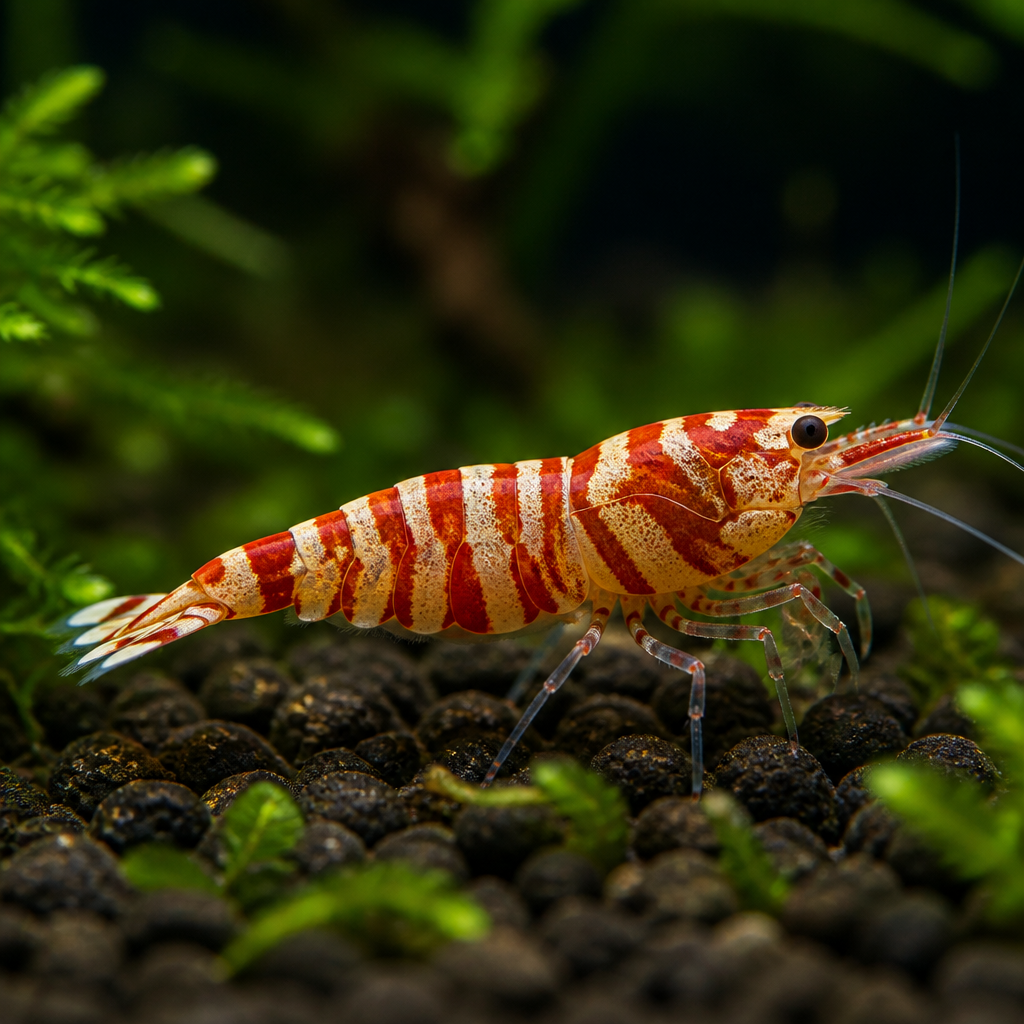
Caridina profile
Red Tiger shrimp
Caridina mariae "Red Tiger"
Red Tiger shrimp are selected Caridina mariae with red or warm red-brown Tiger line traits. They need stable Caridina care and line-conscious breeding.
Written by
- Published
- Updated
Quick verdict
Suitable for: Keepers who like Tiger shrimp and want to maintain a red line. Watch especially: adjust KH, GH and TDS slowly.
Quick care card
Use this card as a starting point. Always check whether your aquarium is stable enough for sensitive species.
Temperature
19 - 24 °C
pH
6.2 - 7.3
GH
4 - 10 °dH
KH
0 - 4 °dH
TDS
140 - 240 ppm
Aquarium
From 40 liters
Difficulty
Intermediate
Behavior
Peaceful red-selected Caridina Tiger line
Feeding
Biofilm, leaves, shrimp food and light supplemental feeding
Breeding
Breeds in freshwater with direct development
Best match
Keepers who like Tiger shrimp and want to maintain a red line
Important
Do not mix Red Tigers with other Tiger lines if you want predictable offspring. Stable water and a mature tank matter more than strong feeding or fast growth.
Care in practice
These are the points that most often make the difference between survival and a stable colony.
Aim for stable soft to medium-soft water: 19-24 degrees Celsius, pH 6.2-7.2, GH 4-8, KH 1-4 and TDS around 140-220 ppm. Keep ammonia and nitrite at zero and avoid warm, unstable water.
Use a mature shrimp tank with moss, wood, leaf litter, protected filtration and plenty of surface for biofilm. A dedicated tank is best for line breeding.
Use biofilm and leaves as the base. Add small amounts of quality shrimp food, mineral food and occasional fine food for young. Avoid heavy feeding.
Red Tigers are peaceful group shrimp. They graze actively in calm tanks and need cover after molting.
They can live with peaceful small tank mates, but shrimp-only is safer for breeding. Other Caridina lines can cross and should be avoided unless you have a breeding plan.
Breeding is freshwater and direct. Select for healthy, fertile animals first, then red expression, striping and line stability.
Common mistakes are treating them as red Neocaridina, mixing Tiger lines, using a young tank, overfeeding, ignoring summer heat and selecting only for color while ignoring health.
Background and identification
Extra context helps you identify, compare and keep the species safely.
Red Tiger shrimp are aquarium-selected forms of Caridina mariae, a Tiger shrimp species linked with South China and Hong Kong in hobby sources.
Red Tiger appearance varies by line. Some show red-brown body color and darker striping, while others are selected mainly for reddish markings over a lighter base.
Red Tiger is a selected Tiger shrimp line. It is different from red Neocaridina and from Crystal Red Bee shrimp, even though some water ranges may overlap.
Full species profile
Red Tiger shrimp are selected Caridina mariae with reddish tiger markings or a warmer red-brown body tone, depending on the line. They are peaceful freshwater breeding shrimp, but they still need stable Caridina conditions.
Care
Keep Red Tigers in a mature aquarium with soft to medium-soft water, protected filtration, moss, wood, leaves and enough biofilm. They are more demanding than Neocaridina and should not be added to a fresh tank.
Water and breeding
A practical range is 19-24 degrees Celsius, pH 6.2-7.2, GH 4-8, KH 1-4 and TDS around 140-220 ppm. They breed in freshwater with direct development. Keep lines separate if you want reliable red Tiger offspring.
Frequently asked questions
Short answers to common questions about Red Tiger shrimp.
Sources and review
Last reviewed: June 15, 2026. Different values are used in the hobby; choose stability over chasing numbers.
Sources for accepted names, classification and synonyms.
Sources for water values, temperature and stable care.
Practical sources for setup, feeding, behavior and breeding.