Caridina profile
Indian Zebra shrimp
Caridina cf. babaulti "Zebra"
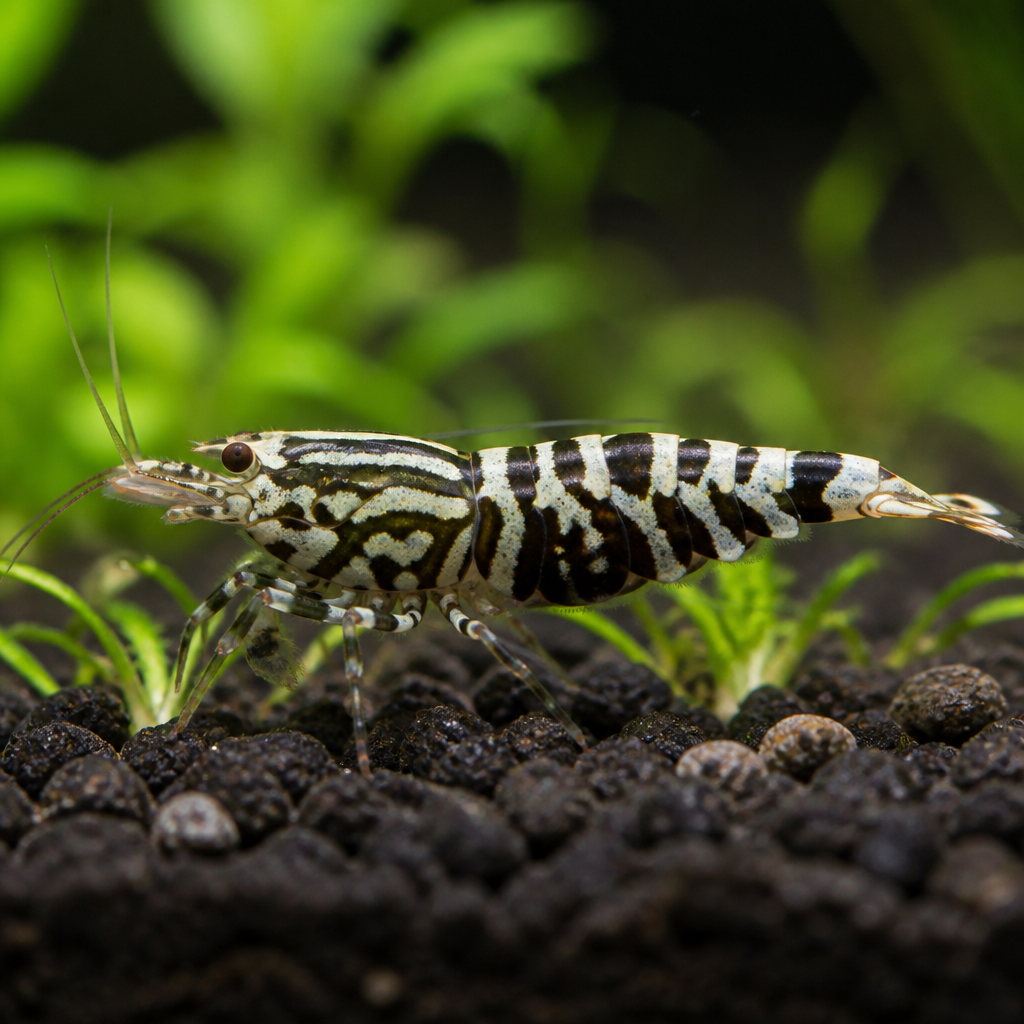
Indian Zebra shrimp are usually traded as Caridina cf. babaulti "Zebra". They need stable clean water and cautious line identification because trade names vary.
Written by
- Published
- Updated
Quick verdict
Suitable for: Keepers who want a hardy Caridina-style shrimp and accept some trade-name uncertainty. Watch especially: adjust KH, GH and TDS slowly.
Quick care card
Use this card as a starting point. Always check whether your aquarium is stable enough for sensitive species.
Temperature
20 - 26 °C
pH
6.8 - 7.8
GH
4 - 14 °dH
KH
2 - 8 °dH
TDS
100 - 220 ppm
Aquarium
From 30 liters
Difficulty
Intermediate
Behavior
Peaceful small Caridina with zebra-like patterning
Feeding
Biofilm, leaves, fine shrimp food and light supplemental feeding
Breeding
Often breeds in freshwater, but confirm the exact line
Best match
Keepers who want a hardy Caridina-style shrimp and accept some trade-name uncertainty
Important
Use cautious wording with this shrimp: taxonomy and trade labels are not always consistent. Check the seller line and water values before mixing or breeding.
Care in practice
These are the points that most often make the difference between survival and a stable colony.
Use stable water around 20-26 degrees Celsius, pH 6.5-7.8, GH 5-12, KH 2-8 and TDS about 150-280 ppm. Avoid ammonia, nitrite, copper and sudden mineral swings.
Use a mature planted shrimp tank with moss, leaves, wood, biofilm and a protected filter intake. Avoid sterile new tanks and unstable water.
Feed lightly with biofilm and leaf litter as the base. Add small shrimp foods, mineral food and occasional fine food for young. Avoid heavy feeding.
Indian Zebra shrimp are peaceful group shrimp. They do best with cover, stable routines and low-stress tank mates.
They can live with peaceful small fish or other shrimp if water values match, but a dedicated group is better for breeding and identification. Avoid predators and avoid mixing uncertain Caridina lines.
Many hobby lines breed in freshwater with direct development. Provide biofilm, moss, leaves and a protected intake for young. Confirm the line if breeding behavior is important to you.
Common mistakes are trusting trade names blindly, mixing uncertain Caridina lines, using a new tank, overfeeding, ignoring copper risk and expecting every animal sold as Zebra to behave identically.
Background and identification
Extra context helps you identify, compare and keep the species safely.
The trade name is usually connected with the Caridina babaulti complex from South Asia, but exact identification in the aquarium trade can be inconsistent.
Indian Zebra shrimp are small, usually translucent to brownish or greenish with darker zebra-like striping. Pattern strength varies by line and condition.
They are not Neocaridina and not Bee shrimp. Compared with Neocaridina they can be less common and more variable in trade identification. Compared with Bee shrimp they usually do not need extreme soft acidic water.
Full species profile
The Indian Zebra shrimp is usually traded as Caridina cf. babaulti "Zebra". It is a small Caridina with striped patterning, but trade names and exact taxonomy are not always used consistently.
Care level
Care is usually closer to a hardy small Caridina than to high-grade Bee shrimp. Use a mature tank, stable clean water and avoid extremes. Because trade lines vary, match your care to the water values used by the seller when possible.
Water and setup
A practical range is 20-26 degrees Celsius, pH 6.5-7.8, GH 5-12, KH 2-8 and TDS around 150-280 ppm. Use plants, moss, leaves, biofilm and protected filtration.
Breeding
Many hobby lines breed in freshwater with direct development, but confirm the line if you are buying specifically to breed. Keep them separate from other Caridina if you want to avoid crossing or confusing offspring.
Frequently asked questions
Short answers to common questions about Indian Zebra shrimp.
Sources and review
Last reviewed: June 15, 2026. Different values are used in the hobby; choose stability over chasing numbers.
Sources for accepted names, classification and synonyms.
Sources for water values, temperature and stable care.
Practical sources for setup, feeding, behavior and breeding.