Caridina profile
Crystal Golden Bee shrimp
Caridina cantonensis var. Golden Bee
Crystal Golden Bee shrimp are pale to white Caridina from the Bee shrimp breeding complex. They are an attractive but sensitive line for mature soft-water aquariums.
Written by
- Published
- Updated
Quick verdict
Suitable for: Intermediate keepers with a mature soft-water Caridina setup. Watch especially: adjust KH, GH and TDS slowly.
Quick care card
Use this card as a starting point. Always check whether your aquarium is stable enough for sensitive species.
Temperature
20 - 24 °C
pH
5.8 - 6.8
GH
4 - 6 °dH
KH
0 - 2 °dH
TDS
100 - 180 ppm
Aquarium
From 25 liters
Difficulty
Difficult
Behavior
Peaceful but more sensitive Caridina group shrimp
Feeding
Biofilm, fine shrimp food and light plant-based supplements
Breeding
Breeds in freshwater, but only with stable soft-water conditions
Best match
Intermediate keepers with a mature soft-water Caridina setup
Important
Do not keep these shrimp like Neocaridina. They need stable soft water, very low KH and a mature aquarium. Avoid tap-water swings, active substrate exhaustion, high nitrate, copper, warm temperatures and large sudden water changes.
Care in practice
These are the points that most often make the difference between survival and a stable colony.
Use remineralized RO water as the safest base. A practical range is 19-24 degrees Celsius, pH about 5.8-6.8, GH 4-6, KH 0-1 and TDS roughly 100-160 ppm. Stability is more important than one exact number. Active substrate helps buffer pH, but it must be monitored as it ages.
Use a mature aquarium with active substrate, gentle filtration, moss, fine plants, leaf litter and plenty of biofilm. A sponge filter or protected intake is important for shrimplets. Let the tank mature well beyond the basic nitrogen cycle before adding sensitive Caridina.
These shrimp graze on biofilm, algae film, detritus and microorganisms. Supplement sparingly with high-quality shrimp food, leaf litter and fine powdered food for shrimplets. Avoid heavy feeding because soft-water Caridina tanks can become unstable quickly.
Keep them in a group of at least 10 to 15 animals. They are peaceful and do best in calm species tanks. If they hide constantly, stop breeding or show failed molts, check stability, oxygen, nitrate, GH/KH and recent maintenance changes.
A shrimp-only tank is strongly recommended. Fish increase stress and eat shrimplets. Do not mix different Caridina breeding lines unless you are intentionally breeding and understand the genetics, because pattern and color stability can be lost quickly.
These Caridina lines breed fully in freshwater. Females carry eggs under the abdomen and the young hatch as miniature shrimp. Breeding depends on stable soft water, mature biofilm, gentle filtration and a calm species tank. Sudden changes, nitrate buildup and overfeeding are common reasons breeding slows down.
Common mistakes are using hard tap water, allowing KH to rise, adding shrimp too early, overfeeding, letting active substrate exhaust unnoticed, keeping the tank too warm, doing large water changes and mixing breeding lines without a clear goal.
Background and identification
Extra context helps you identify, compare and keep the species safely.
These aquarium lines come from the broader Bee shrimp and Caridina breeding complex. Many modern color forms are selectively bred aquarium strains rather than simple wild species. Treat trade names as breeding lines unless the breeder provides exact lineage.
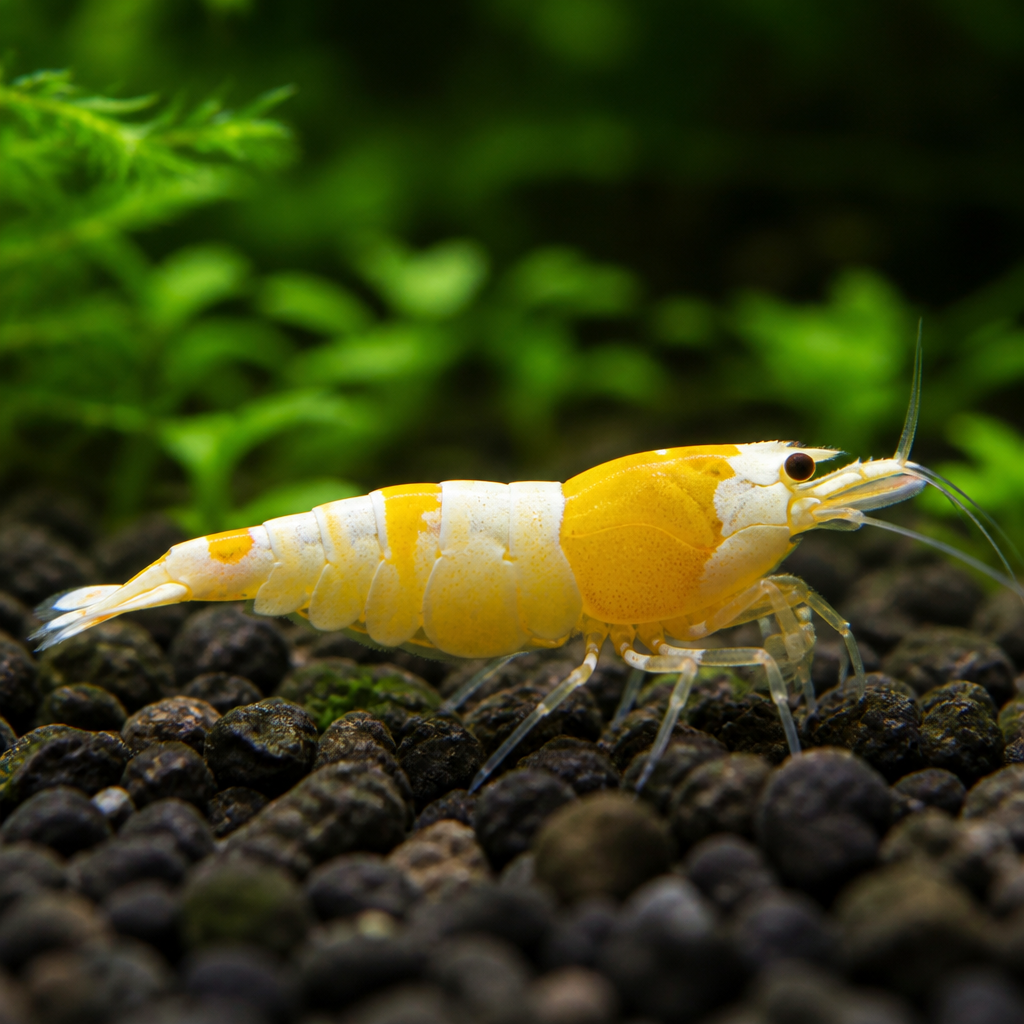
Crystal Golden Bee shrimp are mostly white to cream-colored, sometimes with warm golden tones. The appeal is a clean, light body rather than strong red or black markings.
Golden Bee shrimp share care needs with Crystal Red and Crystal Black shrimp, but their appearance focuses on pale white or cream coloration instead of colored banding.
Full species profile
Crystal Golden Bee shrimp are a pale Caridina line within the Bee shrimp breeding world. They need the same careful soft-water approach as Crystal Red and Crystal Black shrimp.
Appearance
They are mostly white, cream or lightly golden. Good animals look clean and healthy, with even coloration and a solid body shape.
Water parameters
These shrimp need stable soft water. A practical range is 19-24 degrees Celsius, pH about 5.8-6.8, GH 4-6, KH 0-1 and TDS roughly 100-160 ppm. Remineralized RO water with active substrate is the safest setup for most keepers.
Aquarium setup
Use a mature tank with active substrate, moss, fine plants, leaf litter, gentle filtration and a protected intake. Do not rush the setup: sensitive Caridina do better in an aquarium that has developed stable biofilm and predictable water values.
Feeding
Biofilm and microfauna are the base. Feed small portions of quality shrimp food and remove leftovers. Fine powdered food can help shrimplets, but overfeeding quickly creates bacterial load and nitrate problems.
Behavior and tank mates
Crystal Golden Bee shrimp are peaceful but more sensitive than Neocaridina. A calm species tank gives the best results. Fish are not recommended if breeding is the goal.
Breeding
They breed fully in freshwater with direct development. Females carry eggs until the young hatch as tiny shrimp. Stable soft water, low stress and mature biofilm matter more than frequent intervention.
Line selection
Keep Golden Bee lines separate if you want predictable pale offspring. Crosses with other Bee or Taiwan Bee lines may produce interesting results, but they are breeding projects rather than simple community choices.
Frequently asked questions
Short answers to common questions about Crystal Golden Bee shrimp.
Sources and review
Last reviewed: June 15, 2026. Different values are used in the hobby; choose stability over chasing numbers.