Caridina profile
Black Tiger Orange Eye shrimp
Caridina mariae "Black Tiger OE"
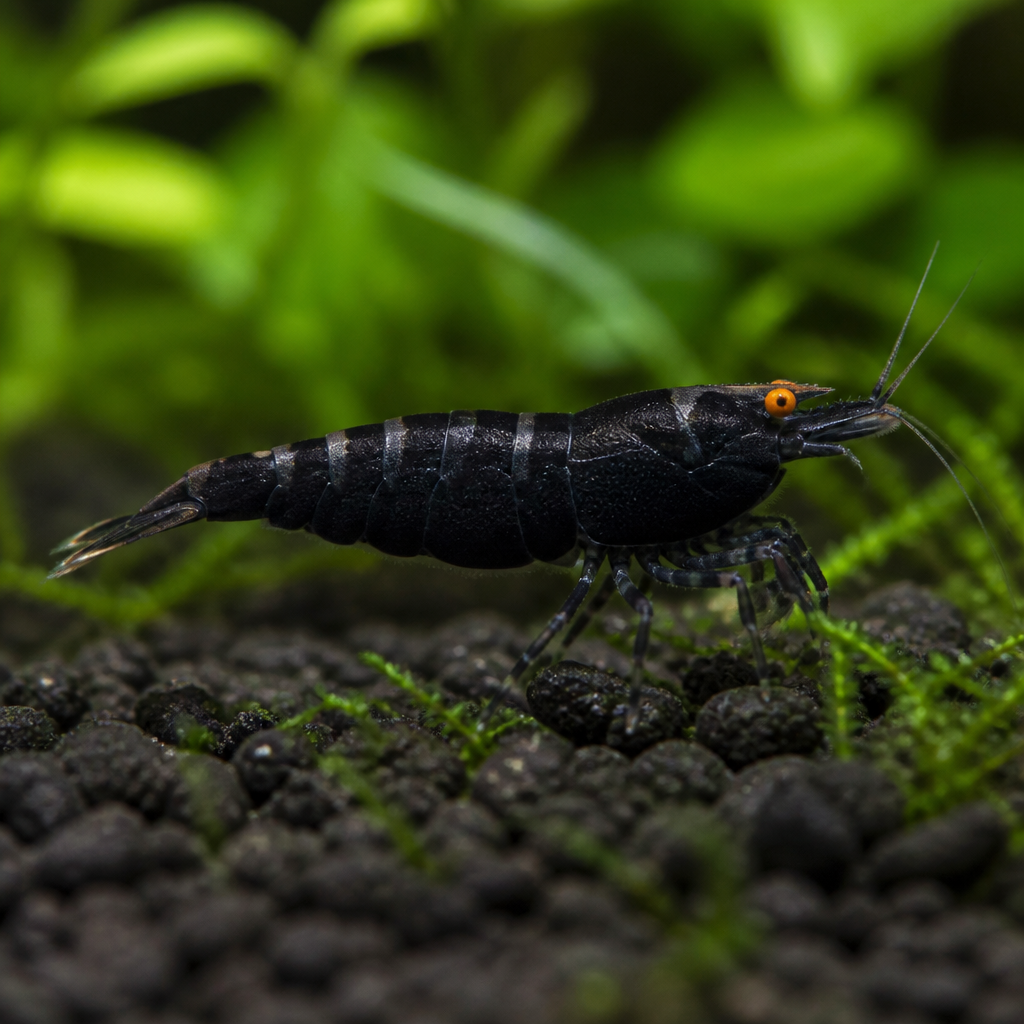
Black Tiger Orange Eye shrimp, often called BTOE, are a dark Caridina mariae line with orange eyes. They are beautiful but should be treated as selective breeding shrimp.
Written by
- Published
- Updated
Quick verdict
Suitable for: Experienced Tiger shrimp keepers who want to maintain a dark orange-eye line. Watch especially: adjust KH, GH and TDS slowly.
Quick care card
Use this card as a starting point. Always check whether your aquarium is stable enough for sensitive species.
Temperature
19 - 24 °C
pH
6.4 - 7.2
GH
5 - 10 °dH
KH
0 - 4 °dH
TDS
120 - 220 ppm
Aquarium
From 40 liters
Difficulty
Difficult
Behavior
Peaceful but sensitive selected Caridina breeding line
Feeding
Biofilm, leaves, fine shrimp food and controlled supplements
Breeding
Breeds in freshwater; line quality depends on selection
Best match
Experienced Tiger shrimp keepers who want to maintain a dark orange-eye line
Important
Keep BTOE shrimp stable and separate if you care about the line. Mixing with other Tiger or Caridina lines can quickly make offspring unpredictable.
Care in practice
These are the points that most often make the difference between survival and a stable colony.
Use stable soft Caridina water around 19-23 degrees Celsius, pH 6.0-7.0, GH 4-8, KH 0-3 and TDS around 120-200 ppm. Low nitrate, zero ammonia and zero nitrite are important.
Use a dedicated mature shrimp tank with protected filtration, moss, wood, leaves and many grazing surfaces. Active substrate can help if your water needs buffering, but stability is more important than chasing a single pH.
Feed lightly. Biofilm and leaf litter are the base, with small portions of quality shrimp food and occasional fine food for young. Avoid protein-heavy overfeeding.
BTOE shrimp are peaceful and do best in a calm group. They can be shy in bright or busy aquariums, so cover and low stress improve behavior and breeding.
A shrimp-only tank is best. Avoid predators, avoid fish if you want maximum shrimplet survival and avoid other Caridina lines unless crossbreeding is intentional.
They breed in freshwater. Select for healthy animals first, then dark color, orange eyes and good fertility. Because this is a line trait, not every offspring may match the ideal.
Common mistakes are mixing BTOE with other lines, buying weak animals only for color, using unstable water, allowing warm summer temperatures, overfeeding and expecting every offspring to be show quality.
Background and identification
Extra context helps you identify, compare and keep the species safely.
Black Tiger Orange Eye shrimp are selected aquarium forms of Caridina mariae. They are maintained as a breeding line rather than treated as a separate wild species.
The goal is a dark to black body with visible orange eyes. Pattern density and darkness vary by line, age, sex and stress level.
Compared with regular Tiger shrimp, BTOE has stronger line-selection pressure for dark body color and orange eyes. Compared with Taiwan Bee lines it may be somewhat less extreme in water needs, but still requires serious Caridina stability.
Full species profile
Black Tiger Orange Eye shrimp, often shortened to BTOE, are selected Caridina mariae with a dark body and orange eyes. They are striking shrimp, but good animals require stable care and careful breeding selection.
Care level
BTOE shrimp are not beginner cleanup shrimp. They are Caridina breeding shrimp that need stable soft to medium-soft water, low stress and a mature aquarium with plenty of biofilm.
Water parameters
A practical range is 19-23 degrees Celsius, pH 6.0-7.0, GH 4-8, KH 0-3 and TDS around 120-200 ppm. Keep oxygen high, nitrate low and water changes gentle.
Breeding
They breed in freshwater, but line quality depends on selection. Keep them separate from other Tiger and Caridina lines if you want to preserve dark body color and orange eyes.
Frequently asked questions
Short answers to common questions about Black Tiger Orange Eye shrimp.
Sources and review
Last reviewed: June 15, 2026. Different values are used in the hobby; choose stability over chasing numbers.
Sources for accepted names, classification and synonyms.
Sources for water values, temperature and stable care.
Practical sources for setup, feeding, behavior and breeding.