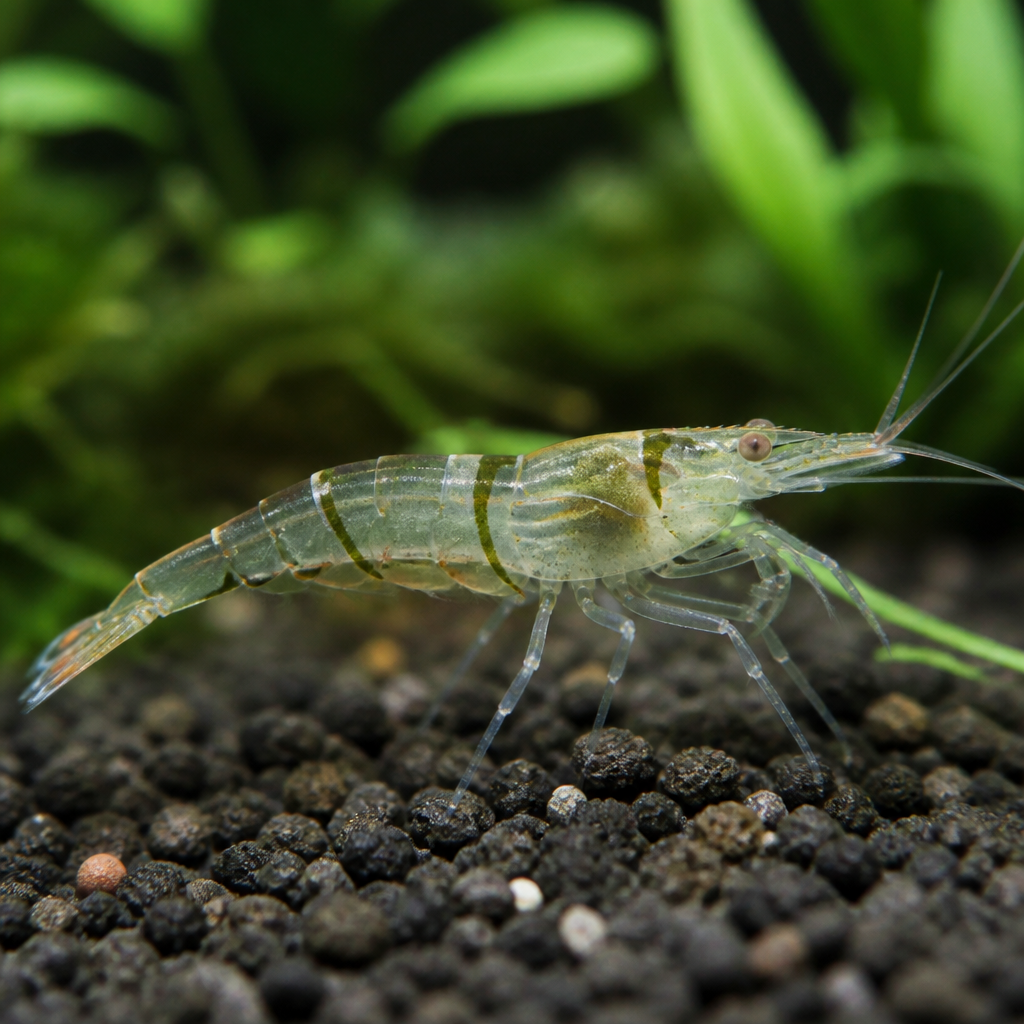
Filter-feeding shrimp profile
Bamboo shrimp
Atyopsis moluccensis
Bamboo shrimp are peaceful fan shrimp that filter fine food from flowing water. Their care is about flow, oxygen and suspended food rather than ordinary shrimp pellets.
Written by
- Published
- Updated
Quick verdict
Suitable for: Keepers with a mature, oxygen-rich aquarium and interest in targeted feeding. Watch especially: check flow and suspended food.
Quick care card
Use this card as a starting point. Always check whether your aquarium is stable enough for sensitive species.
Temperature
22 - 28 °C
pH
6.5 - 7.5
GH
6 - 15 °dH
KH
3 - 8 °dH
TDS
150 - 300 ppm
Aquarium
From 80 liters
Difficulty
Intermediate
Behavior
Peaceful filter-feeding shrimp that sits in the current with open fans
Feeding
Fine suspended food, microorganisms, detritus, spirulina and powdered feeds
Breeding
Larvae need brackish to marine water; freshwater breeding is not realistic
Best match
Keepers with a mature, oxygen-rich aquarium and interest in targeted feeding
Important
The biggest risk is slow starvation in a tank that looks clean. If the shrimp scrapes the bottom with its fans often, improve feeding in the current.
Care in practice
These are the points that most often make the difference between survival and a stable colony.
Use stable, oxygen-rich water around 22-28 degrees Celsius, pH 6.5-7.5, GH 6-15, KH 3-8 and TDS about 150-300 ppm. Keep ammonia and nitrite at zero and avoid copper medication.
Use a mature aquarium of roughly 80 liters or more with strong filtration, open flow paths and secure perches on wood or stone. Provide both feeding spots in the current and quiet hiding places for molting.
Feed very fine foods in the current, preferably with a pipette or syringe. Use multiple tiny portions rather than one large cloud of powder. Sinking tablets do not replace suspended food for fan shrimp.
Bamboo shrimp are peaceful and often sit for long periods with fans open. A small group can work in a large enough tank with several feeding spots.
They can live with peaceful small fish, snails and dwarf shrimp if water and flow needs overlap. Avoid fish that nip fan hands, large predators, crayfish and crabs.
Females can carry many small eggs, but the larvae are planktonic and need brackish to marine water. Adults are freshwater shrimp, so breeding is a specialist project rather than normal community-tank breeding.
Common mistakes are keeping them in a young or very clean tank, buying them as algae eaters, feeding only pellets, providing too little current, ignoring frequent substrate scraping and overdosing powdered food.
Background and identification
Extra context helps you identify, compare and keep the species safely.
Atyopsis moluccensis is linked with Southeast Asian flowing waters, including Indonesia and surrounding regions in hobby sources. The natural lifestyle explains the need for oxygen, current and fine suspended food.
Bamboo shrimp are much larger than dwarf shrimp, often around 8-10 cm. Color varies from beige and brown to orange-brown, greenish or reddish-brown, often with a lighter dorsal stripe or mottled pattern.
Unlike Amano or Neocaridina shrimp, Bamboo shrimp do not graze surfaces as their main feeding method. Compared with Vampire shrimp they usually stay smaller and are often more visible in the flow.
Full species profile
The Bamboo shrimp, Atyopsis moluccensis, is a large peaceful filter-feeding shrimp from flowing waters in Southeast Asia. It uses fan-like hands to catch fine food particles from the current. It is not a normal dwarf shrimp and not a glass-cleaning algae eater.
Care focus
The key is food in the flow. A Bamboo shrimp that often scrapes the substrate with its fans may not be getting enough fine suspended food. At the same time, too much powdered food can damage water quality, so the aquarium must be mature and well filtered.
Water and setup
A practical range is 22-28 degrees Celsius, pH 6.5-7.5, GH 6-15, KH 3-8 and TDS around 150-300 ppm. Use a mature aquarium with oxygen-rich flow, stones, wood and secure perches directly in or near the current.
Feeding and breeding
Feed very fine foods into the flow: powdered flakes, spirulina, chlorella, baby fish food, filter-feeder food or tiny frozen foods. Breeding in a normal freshwater aquarium is not realistic because the larvae need brackish to marine conditions.
Frequently asked questions
Short answers to common questions about Bamboo shrimp.
Sources and review
Last reviewed: June 15, 2026. Different values are used in the hobby; choose stability over chasing numbers.
Sources for accepted names, classification and synonyms.
Sources for water values, temperature and stable care.
Practical sources for setup, feeding, behavior and breeding.