Caridina profile
Amano shrimp
Caridina multidentata
The Amano shrimp is a hardy, large Caridina known for grazing algae and biofilm in planted aquariums. It is beginner-friendly only in a mature, stable and well-covered tank.
Written by
- Published
- Updated
Quick verdict
Suitable for: Beginners and planted community tanks that need a strong grazer, not easy breeding. Watch especially: adjust KH, GH and TDS slowly.
Quick care card
Use this card as a starting point. Always check whether your aquarium is stable enough for sensitive species.
Temperature
18 - 26 °C
pH
6.5 - 8
GH
5 - 15 °dH
KH
1 - 10 °dH
TDS
120 - 300 ppm
Aquarium
From 40 liters
Difficulty
Easy
Behavior
Active peaceful grazer that is bolder than many dwarf shrimp
Feeding
Biofilm, algae, leaf litter, leftovers and supplemental shrimp food
Breeding
Females carry eggs, but larvae need brackish to salt water
Best match
Beginners and planted community tanks that need a strong grazer, not easy breeding
Important
Amano shrimp are helpers, not an algae solution by themselves. Overfeeding makes them choose easy food over algae, and open tanks can lead to escapes.
Care in practice
These are the points that most often make the difference between survival and a stable colony.
Use a stable range around 18-26 degrees Celsius, pH 6.5-8.0, GH 5-15, KH 1-10 and TDS about 120-300 ppm. Ammonia and nitrite must be zero; avoid copper medication and heavy metals.
Use at least a mature medium-sized planted tank with wood, stones, moss, leaves, open grazing surfaces, safe filtration and a tight lid. Flow is fine, but hiding places are important after molting.
Amano shrimp graze biofilm, thread algae, soft green algae, plant debris and leftover food. Supplement with shrimp food, algae-based food, vegetables or mineral food in very small portions. Too much easy food reduces algae grazing.
Amano shrimp are active, visible and peaceful. Keep them in a group when the tank has enough space and food. Females are larger and fuller than males.
They combine well with peaceful fish, snails and other shrimp if water values match. They do not cross with Neocaridina or common Bee shrimp. Avoid fish large enough to swallow them.
Amano shrimp are amphidromous. Females carry eggs in freshwater, but the larvae hatch as floating zoea and need brackish to salt water before later returning to freshwater. Breeding them is a separate specialist project.
Common mistakes are buying them as a quick algae fix, overfeeding, using a new tank, ignoring ammonia or nitrite, using copper medication, keeping the water too soft without minerals, leaving the tank open and expecting eggs to become young in freshwater.
Background and identification
Extra context helps you identify, compare and keep the species safely.
Caridina multidentata was long sold as Caridina japonica. Adults live in freshwater streams and rivers connected to the sea; larvae drift toward brackish or marine water and juveniles return upstream.
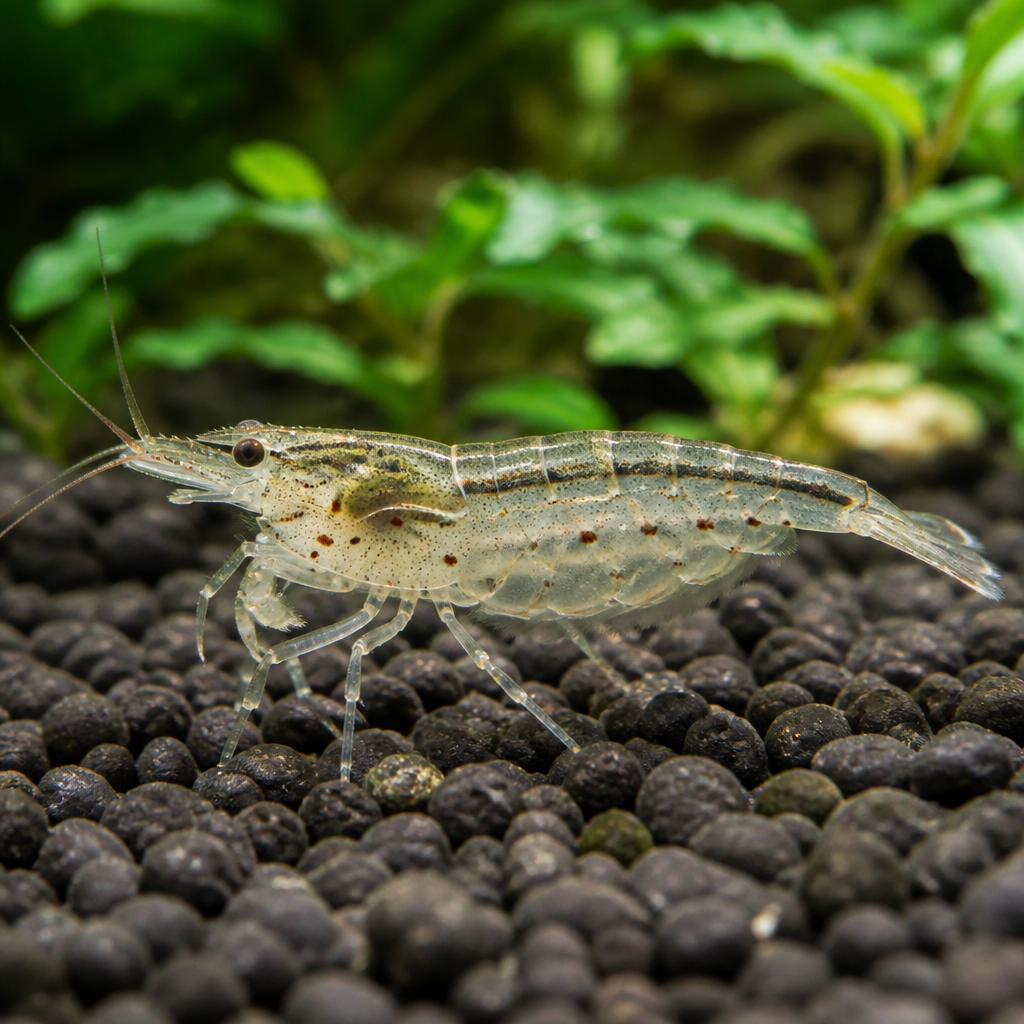
Amano shrimp are transparent to grey, brown, greenish or pale blue-grey, often with a light dorsal stripe and reddish-brown to dark dots or short dashes along the sides. Females are usually larger and fuller.
Amano shrimp are larger and stronger grazers than Neocaridina, but they do not breed in freshwater. Unlike Bamboo or Vampire shrimp, they do not use fan hands and do not require suspended filter-feeder food.
Full species profile
The Amano shrimp, Caridina multidentata, is a large, hardy Caridina best known as an algae grazer in planted aquariums. The old name Caridina japonica is still often seen in the hobby.
Who is it for?
Amano shrimp are suitable for beginners with a mature aquarium, stable water and a secure lid. They are useful grazers, but they are not a cure for poor lighting, excess nutrients or neglected maintenance.
Water and setup
A practical range is 18-26 degrees Celsius, pH 6.5-8.0, GH 5-15, KH 1-10 and TDS around 120-300 ppm. Use plants, wood, stones, hiding places, grazing surfaces and a shrimp-safe filter intake. Close gaps around cables and hoses because Amanos can climb and escape.
Feeding and breeding
Amano shrimp eat biofilm, thread algae, soft algae, plant debris and leftover food. Feed sparingly if you want them to keep grazing. Females carry many tiny eggs, but the larvae need brackish to salt water and normally do not survive to juvenile stage in a freshwater community tank.
Frequently asked questions
Short answers to common questions about Amano shrimp.
Sources and review
Last reviewed: June 15, 2026. Different values are used in the hobby; choose stability over chasing numbers.
Sources for accepted names, classification and synonyms.
Sources for water values, temperature and stable care.
Practical sources for setup, feeding, behavior and breeding.